

About
Twenty-five years after 9/11, this second conversation in a two-part series examines the legacy of the wars in Iraq and Afghanistan through the experiences of people and communities who lived through them. Moderated by Razia Iqbal, the discussion will draw on the speakers’ firsthand and professional perspectives on the region to explore how the wars reshaped daily life, politics, and communities, and what their enduring impact means for the region and the United States today.
Biographies
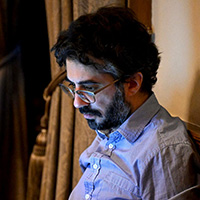
Zaid Al-Ali was born in Madrid in 1977, spent the first ten years of his life in New York and the second ten years in London. His family is from Baghdad, Iraq. At the start of the Iran-Iraq war in 1980, his father (who was Iraq’s ambassador to the United Nations) resigned his position in protest, thereby effectively forcing his entire family into exile until 2003. Zaid graduated with law degrees from King’s College London in 1997, from the Université de Paris I (Panthéon-Sorbonne) in 1999 and from Harvard Law School in 2001. He started his legal career at Shearman & Sterling LLP, where he practiced international commercial and investment arbitration in its Paris and London offices. In February 2005, he moved to the Middle East to work for the United Nations Assistance Mission for Iraq. He was a legal adviser for the Office of Constitutional Support, which was mandated to provide advice to the Iraqi constitutional drafting committee. After the drafting process ended, he worked on parliamentary and judicial reform in Iraq, working closely with legal advisers in key positions in the state to increase parliament’s ability to exercise oversight on the executive branch of government, and to improve the courts’ effectiveness.
By 2010, Zaid had decided that the efforts that he and his Iraqi colleagues were making were not leading to the types of improvements that they had hoped for, and left the United Nations to consider other options. He spent an academic term teaching international trade law in Paris, and was in Baghdad when Tunisian dictator Zine El Abidine Ben Ali was deposed in a popular uprising on 14 January 2011. From that time onwards, Zaid has been focusing on constitutional reform in the Arab region, with a specific focus on Tunisia, Libya, Egypt and Yemen.
Zaid has published widely in the international press, including in the New York Times, the Washington Post, the Guardian, the New York Review of Books, Foreign Policy, al-Jazeera and al-Hayat, among many others. He is also quoted regularly in the international press on Iraqi developments and on constitutional reform issues in the Arab region, including in the New York Times, the Financial Times, the BBC, National Public Radio, the Guardian, the Daily Telegraph, amongst many others. He has contributed a large number of chapters to edited volumes on constitutional law and on reform efforts in the Middle East. He has lectured and spoken on these same issues at Harvard University, the London School of Economics, Chatham House, Edinburgh University, the University of Chicago, the Chicago Council on Global Affairs, the Carnegie Council for Ethics in International Affairs, New York University, amongst many others.
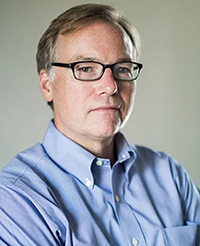
Steve Coll is an editor at the Economist, the author of nine books of nonfiction, and a two-time winner of the Pulitzer Prize. Between 1985 and 2005, he was a reporter, foreign correspondent and senior editor at the Washington Post. There he covered Wall Street, served as the paper’s South Asia correspondent in New Delhi, and was the Post’s first international investigative correspondent, based in London. He served as managing editor of the Post between 1998 and 2004. The following year, he joined The New Yorker, where was a staff writer until 2023, when he joined the Economist as a senior editor.
Coll is the author of “Ghost Wars: The Secret History of the CIA, Afghanistan, and Bin Laden, From the Soviet Invasion to September 10, 2001,” published in 2004, for which he received an Overseas Press Club Award and a Pulitzer Prize. His 2008 book, “The Bin Ladens: An Arabian Family in the American Century,” won the PEN/John Kenneth Galbraith Award for Nonfiction in 2009 and was a finalist for the Pulitzer Prize for Biography. His book “Private Empire: ExxonMobil and American Power” won the Financial Times/Goldman Sachs Award as the best business book of 2012. His book "Directorate S," a follow-up to "Ghost Wars," received the 2018 National Book Critics Circle Award for Nonfiction.
His most recent book, published in February 2024, is “The Achilles Trap: Saddam Hussein, the CIA, and the Origins of America’s Invasion of Iraq.”
He has four children and is married to Eliza Griswold, the journalist and poet. He has a B.A. in English and history from Occidental College.
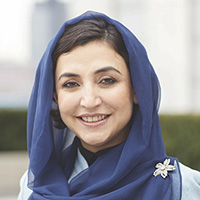
Ambassador Adela Raz served as the last Ambassador of the Islamic Republic of Afghanistan to the United States. Prior to that Amb. Raz served as the first female Ambassador and Permanent Representative of Afghanistan to the United Nations. At the U.N., Amb. Raz was the Vice President of the 75th session of the General Assembly, and was also appointed by the President of U.N’s General Assembly to serve as the co-coordinator on COVID-19-related initiatives.
Before her arrival at the U.N. Amb. Raz was the Deputy Foreign Minister in Afghanistan. At the Ministry of Foreign Affairs (MFA,) she managed the regional and economic cooperation portfolios and led the two major platforms: the Regional Economic Cooperation Conferences on Afghanistan and the Heart of Asia – Istanbul Process. On behalf of MFA, she helped to manage and coordinate the Brussels (2016) and Geneva (2018) Donor Conferences on Afghanistan and led the negotiations on the outcome documents.
In 2013, she served as the first female Deputy Spokesperson and Director of Communications for President Hamid Karzai.
She began her career with the U.N. Assistance Mission in Afghanistan and continued to work in a variety of positions at various international development organizations in the U.S. and Afghanistan.
Amb. Raz holds a Master of Arts degree in Law and Diplomacy from the Fletcher School at Tufts University, and a Bachelor of Arts, with honors, with triple majors in International Relations, Political Science, and Economics from Simmons University in Boston. She also earned a certificate in International Development from the Fletcher School at Tufts University.
__
Sponsorship of an event does not constitute institutional endorsement of external speakers or views presented.
Please note that registration does not guarantee admission to the event. Entry is subject to venue capacity and other conditions.