
Background
Five years after the Taliban's return to power in Afghanistan, the country continues to face profound political, humanitarian, social, economic, and human rights challenges. While the scale of nationwide armed conflict has declined, sustainable peace requires more than the absence of war. It requires legitimate and inclusive institutions, the rule of law and accountability, respect for human rights, meaningful political participation including the full and equal participation of women, justice, social trust, and peaceful mechanisms for addressing political and societal differences.
Despite continued diplomatic engagement through various international mechanisms, meaningful progress toward a durable and inclusive political settlement remains elusive. One of the most consequential shortcomings of current efforts has been the systematic exclusion of Afghan women from public and political life, alongside insufficient attention to national healing and reconciliation as essential foundations for lasting peace.
Afghan women have been among the primary victims of Taliban’s gender persecution, and an institutionalized regime of systematic oppression amounting to gender apartheid. But they must not be viewed solely as beneficiaries of protection. They are political stakeholders and among Afghanistan's most resilient advocates for peace, justice, social cohesion, and an inclusive future. Despite severe restrictions, Afghan women continue to lead humanitarian and community initiatives, preserve social resilience, promote dialogue, and advocate for the rights and aspirations of the Afghan people.
Evidence and experience from peace processes around the world demonstrate that peace is more durable when women participate meaningfully. Afghan women must therefore be full, equal, meaningful participants in any future political process, rather than being confined to parallel or symbolic consultations.
Sustainable peace also requires national healing. Decades of conflict, displacement, political exclusion, atrocities, and competing historical grievances have deeply affected Afghanistan society. Rebuilding trust requires acknowledgment of victims and survivors experiences, justice and accountability, dialogue across communities, and meaningful participation by women, youth, civil society, and Afghanistan's diverse political, ethnic, religious, and other vulnerable communities.
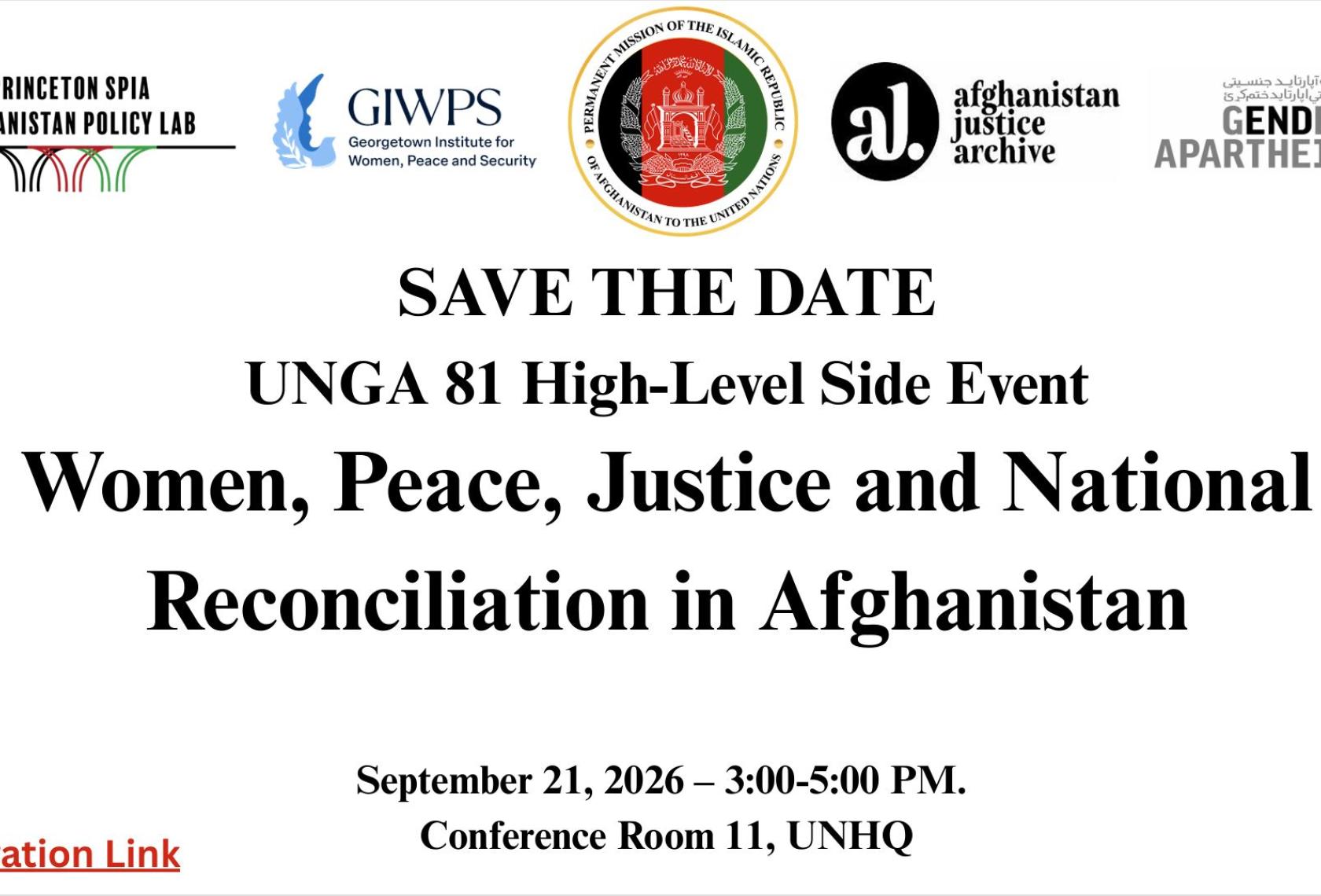
The Afghanistan Policy Lab at Princeton University, Afghanistan Justice Archive, and End Gender Apartheid Campaign will convene this side event. The Afghanistan Policy Lab has identified Peace, National Healing, and Reconciliation as one of its core research pillars, while the End Gender Apartheid Campaign and Afghanistan Justice Archive work to document violations and advance concrete accountability pathways for Afghanistan—essential processes for justice, reconciliation, and national healing. Building on these complementary efforts, the event will examine practical pathways toward an inclusive, Afghan-owned political process that places women at its center and advances sustainable peace through justice, accountability, national healing, and reconciliation.
Objectives
The event aims to:
- Highlight the indispensable role of Afghan women as political stakeholders and leaders in advancing accountability and justice, building sustainable peace, national healing, and reconciliation.
- Examine what sustainable peace in Afghanistan requires beyond the absence of large-scale armed conflict, including legitimate and inclusive institutions, rule of law, rights, justice, participation, and social trust.
- Examine how transitional justice, accountability, acknowledgment of victims' and survivors experiences, national healing, and reconciliation can reinforce one another and contribute to long-term peace.
- Consider how women, youth, civil society, victims of conflict, and Afghanistan's diverse political, ethnic, and religious communities can participate meaningfully in shaping the country's future.
- Identify practical recommendations for the United Nations, Member States, regional actors, and international partners to support women-led peacebuilding and prepare the ground for an inclusive political process.

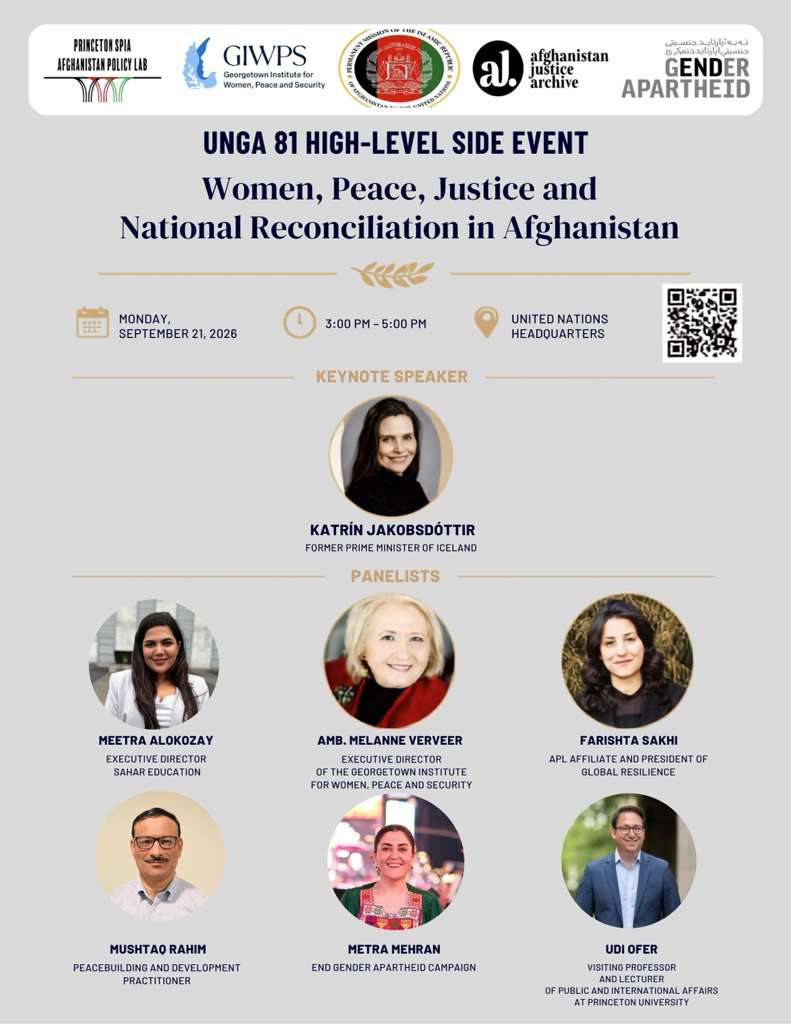
Katrín Jakobsdóttir served as the prime minister of Iceland (2017–2024) and led a three party government. She was a member of the Icelandic parliament from 2007 to 2024. She served as Iceland's minister of education, science, and culture, and of Nordic cooperation from 2009 to 2013. She served as the chair of the Left-Green Movement from 2013 to 2024 and as a vice-chair of that party from 2003. She ran for president of Iceland in 2024 and came in second with 25,1% of the popular vote.
Prime Minister Jakobsdóttir‘s coalition government continued Iceland’s groundbreaking approach to addressing systemic gender inequality. Prime Minister Jakobsdóttir’s government was also at the forefront of climate change policy and committed to make Iceland carbon-neutral before 2040. Her government emphasized the importance the approach of Well-being government and spearheaded a framework of 39 indicators that cover social, economic and environmental dimensions of quality of life. During her time in office, she also led the work on Iceland´s first policy on artificial intelligence that was published in 2021 and her government established a plan to make the largest language models well-usable in the Icelandic language.
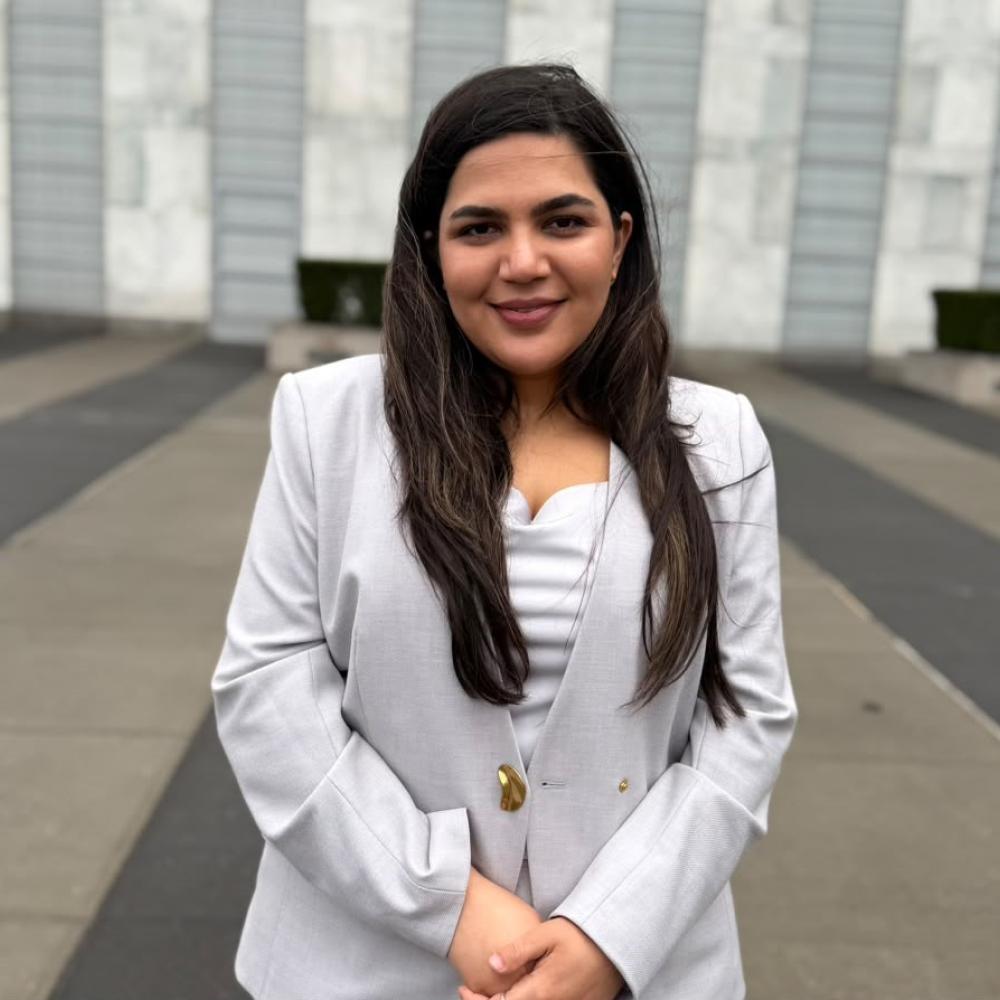
Meetra Alokozay is the Executive Director of Sahar Education and a women’s rights and education leader whose work focuses on the intersection of education, gender equality, civic participation, and the rights of women and girls under repressive systems. She is the Executive Director of Sahar Education, where she leads initiatives supporting Afghan girls and women through education, skills development, and community-based programming inside Afghanistan. With more than a decade of experience across international development, nonprofit leadership, advocacy, and women’s empowerment, Ms. Alokozay works to elevate Afghan women’s voices in policy and international forums, advance locally led approaches to girls’ education, and challenge the exclusion of women from public life and decision-making.
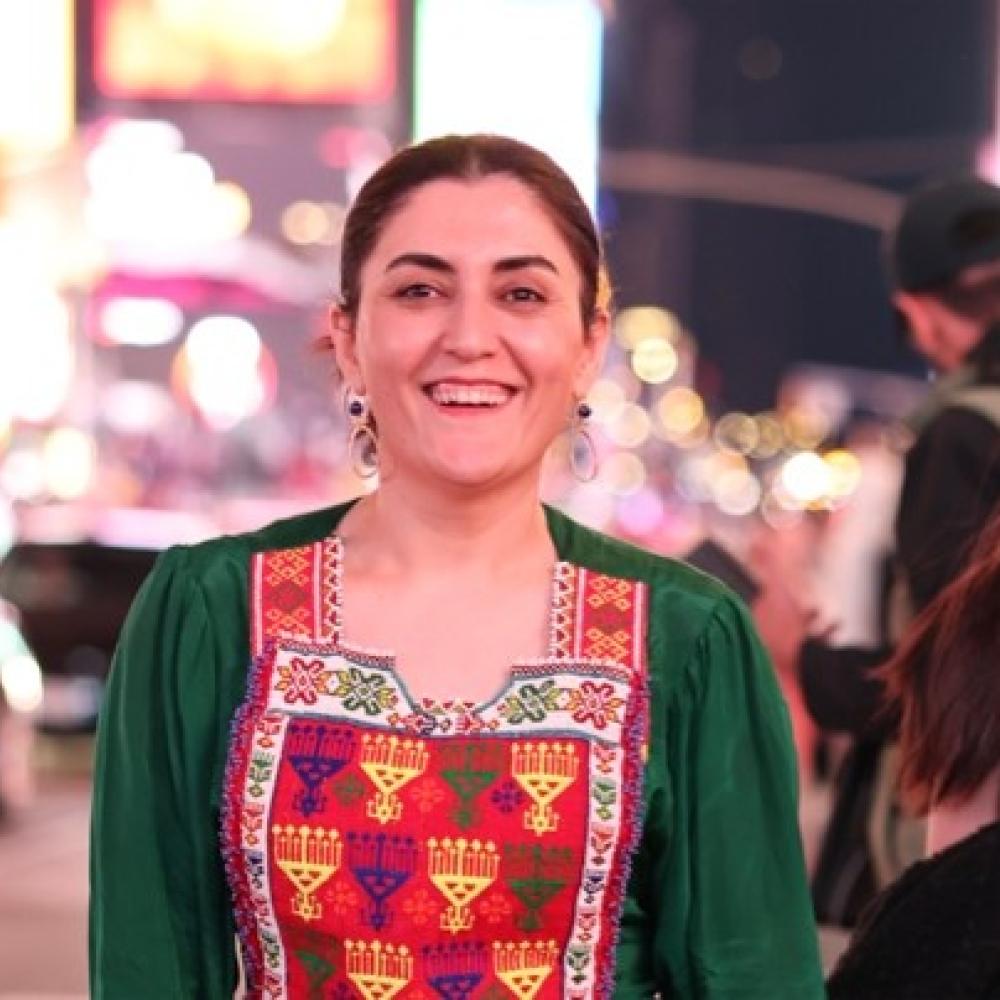
Metra Mehran is a human rights activist with over a decade of experience in international development, Women, Peace, and Security, and gender equality. Now living in exile, she advocates for the recognition of the systematic and institutionalized oppression of women under the Taliban as gender apartheid and its codification under international law. As the founder of the Afghanistan Justice Archive, she monitors Taliban decrees, collects testimonies documenting their impact on women’s lives, and analyzes these findings within the framework of international law. Through this work, she seeks to leverage international accountability mechanisms to hold the Taliban responsible for their violations of women’s rights.
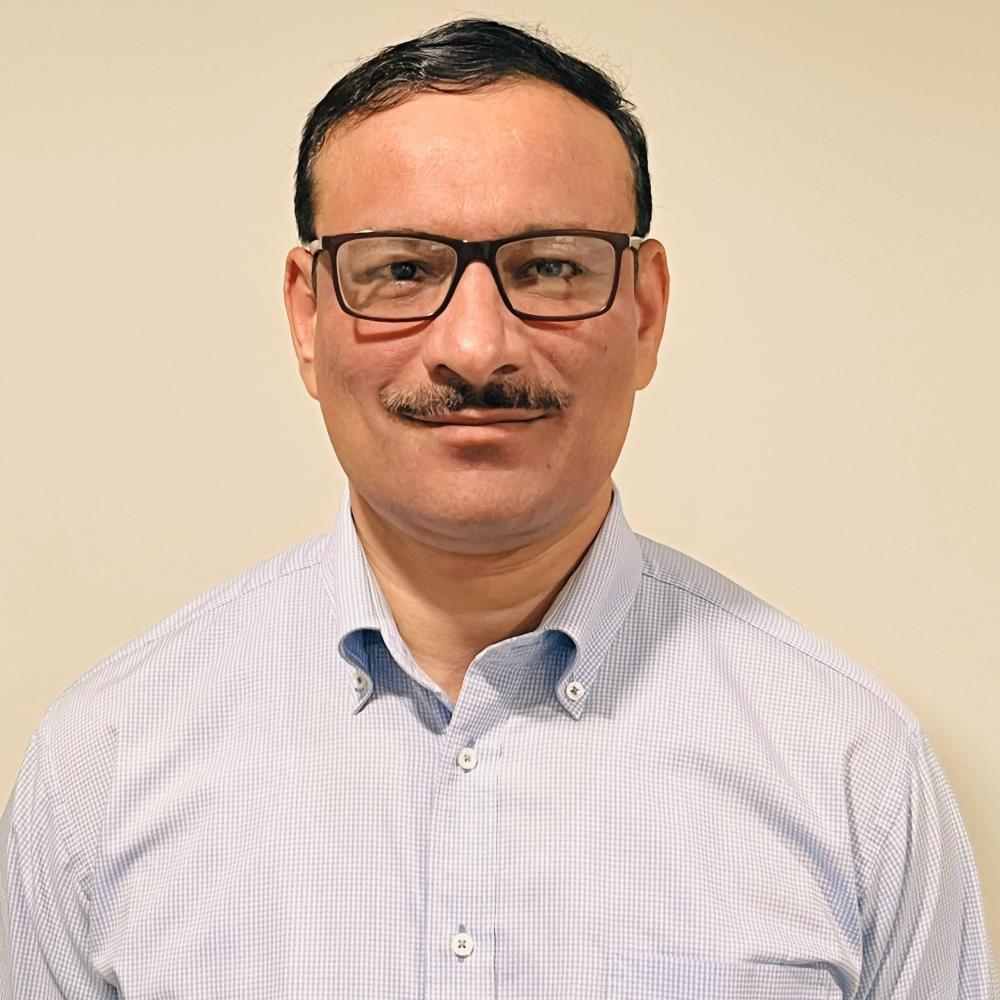
Mushtaq Rahim is a peacebuilding and development practitioner with over two decades of experience working with government, the United Nations, and international organizations in conflict-affected contexts, including Afghanistan and Syria. His work focuses on peace processes, governance, social cohesion, and the challenges of state-building in fragile environments.
He previously served in senior leadership roles with the United Nations Development Programme (UNDP), including Assistant Country Director for Crisis Prevention and Recovery in Afghanistan and Program Specialist for Social Cohesion and Peacebuilding in Syria. He has also held key positions in Afghanistan’s peace architecture, including Deputy CEO of the Executive Secretariat of the High Peace Council and Director of the Peace Agreement Implementation Secretariat.
More recently, Rahim has been working as Director of Research and Evaluation at Alternative Spectrum Consulting and as an evaluation consultant with UN Women, leading large-scale evaluations for the UN agencies and International NGOs in Afghanistan on humanitarian response, livelihood development, gender, and resilience strengthening.
He is currently a doctoral candidate in International Affairs at Johns Hopkins University, School of Advanced International Studies (SAIS). His research and publications examine elements of post-conflict institution building, conflict management, peacemaking, and peacebuilding in Afghanistan.
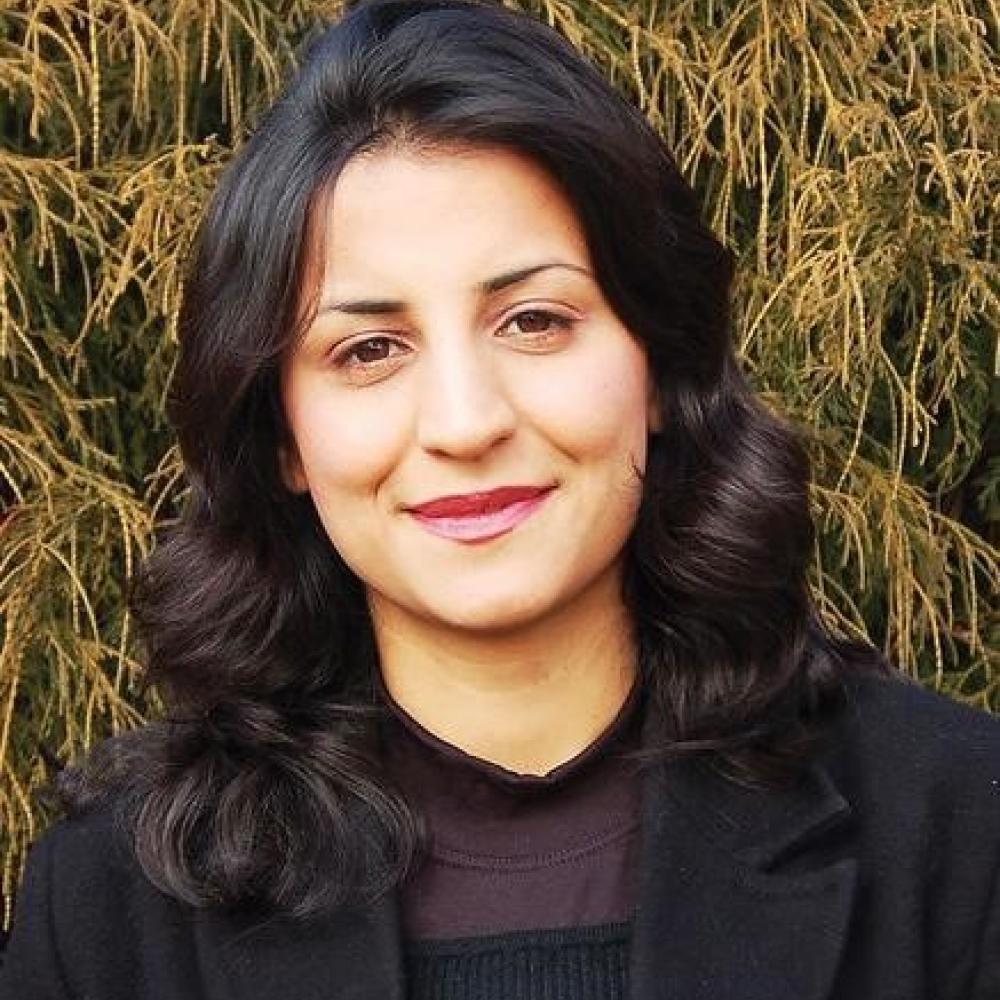
Farishta Sakhi is APL Affiliate and the President of Global Resilience a non-profit organization focused on providing protection support to communities affected by conflict and environmental crisis, and an Adjunct Professor at the Carter School for Conflict Analysis and Resolution at George Mason University and the University of Colorado Boulder. She has over two decades of experience in post-conflict peacebuilding, political transition, democracy and good governance in Afghanistan. Dr. Sakhi served for three years at Freedom House, where she led efforts to promote the protection and safety of human rights defenders in Afghanistan, and previously held senior leadership roles at Afghanistan’s Ministry of Foreign Affairs as Director General and Senior Advisor for Peace and Security Affairs. She also taught at the Political Department of American University of Afghanistan. She remained a fellow at the International Center for Transitional Justice and the Rumsfeld Foundation.

Ambassador Melanne Verveer is the Executive Director of the Georgetown Institute for Women, Peace and Security. She most recently served as the first U.S. Ambassador for Global Women’s Issues, a position to which she was nominated by President Obama in 2009. She coordinated foreign policy issues and activities relating to the political, economic and social advancement of women, traveling to nearly sixty countries, and helped develop the U.S. National Action Plan on Women, Peace and Security. Ambassador Verveer formerly served as the Special Representative on Gender Issues for the OSCE Chairperson-in-Office and is the co-founder of Vital Voices Global Partnership.
Udi Ofer is the John L. Weinberg/Goldman Sachs and Co. Visiting Professor and Lecturer of Public and International Affairs at Princeton University. He is the founding Director of the Policy Advocacy Clinic at Princeton University, a highly intensive clinical program that immerses students in the policy advocacy process, including before the United Nations, Congress, and state government. His research focuses on constitutional rights, criminal justice reform, and human rights law. He teaches courses on policing and civil rights, policy advocacy, and human rights advocacy, including a summer course in Geneva, Switzerland. He is an elected member of the Council on Criminal Justice. He is also Chair of the International Advisory Council of the Association for Civil Rights in Israel.
Ofer has more than 20 years of experience as a constitutional rights lawyer working on issues related to criminal justice reform, national security, free speech and racial justice. For two decades, Ofer worked as an attorney at the American Civil Liberties Union (ACLU), where he helped to transform the organization, expanding its work into new issue areas and tactics. Ofer's work has led to passage of hundreds of laws and policies across the nation to reform the criminal justice system.
Sponsorship of an event does not constitute institutional endorsement of external speakers or views presented.