Dr. Denise Mauzerall is the William S. Tod Professor of Civil and Environmental Engineering and Public and International Affairs at Princeton University holding a joint appointment between the Princeton School of Public and International Affairs and the Department of Civil and Environmental Engineering. Her research examines…
What cumulative impacts needs is a simple solution to a complex problem, or at least a simplified approach if solution is a too ambitious goal. A solution implies that they would cease to exist, yet cumulative impacts are a part of everyone’s everyday lives. The question remains whether a feasible, standardized approach can be…
Thirty years ago, the idea that China could challenge the United States economically, globally, and militarily seemed unfathomable. Yet today, China is considered another great power in the international system. How did China manage to build power, from a weaker resource position, in an international system that was dominated…
We use the term “justice” in many climate contexts (e.g. “just transition”)—and indeed in a variety of other political and policy contexts (e.g. “social justice”). What does it mean? In this talk, I break down some common forms of justice from a philosophical point of view in order to inform climate science and policy. The goal…
Valerie Mueller received her Ph.D. in Agricultural and Resource Economics at the University of Maryland. She is currently an Associate Professor in the School of Politics and Global Studies at Arizona State University (ASU).
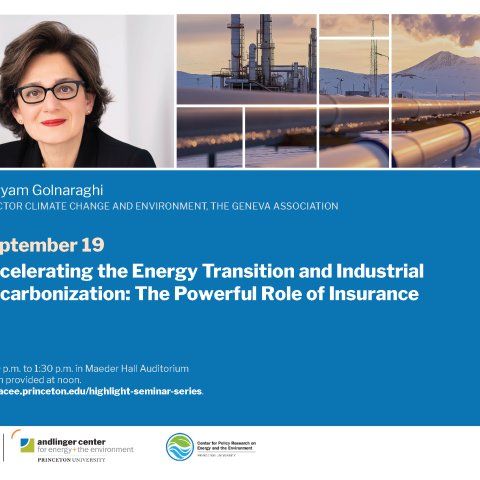
Climate change is changing the characteristic of weather extremes and slow changing climatic trends (physical climate risk). These combined with rising concentration of people and assets in high-risk areas, aging infrastructure and various macroeconomic factors, are leading to growing financial impacts on people, businesses,…