


Current Students
Biographical Profiles of Current Ph.D. Students
Shelley is interested in social vulnerability and environmental hazards. Her research is focused on modelling the social dimensions of vulnerability and incorporating those models into effective hazard mitigation and relief strategies. A geographer by training, she is particularly interested in the influence of place on generating unique interactions between the dimensions of social vulnerability and how those interactions affect both vulnerability and resilience. Prior to joining SPIA, Shelley worked with the University of Illinois Chicago’s School of Public Health and the University of Chicago’s Center for Spatial Data Science. At the University of Illinois Chicago, she was the Assistant Director of Research Services and an Adjunct Lecturer teaching geospatial analysis and social vulnerability courses. At the University of Chicago, she held a research associate appointment working on a place-based social determinants of health model.
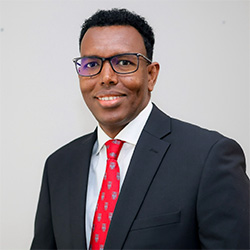
Ali Isse is a third-year PhD candidate in Security Studies and International Affairs Princeton’s School of Public and International Affairs, advised by Professor Christopher Chyba. His research explores the strategic dimensions of nuclear deterrence, coercive diplomacy, and preemption doctrine, focusing on how great powers craft grand strategies to counter nuclear proliferation across diverse geopolitical regions.
Ali has a diverse professional background, having worked in urban planning, research, and grant writing. These roles equipped him with skills in policy analysis, strategic planning, and resource mobilization, enriching his approach to understanding the intersection of policy and practice.
Before joining Princeton, Ali earned an MA in Political Science from the University of Chicago, an MS in City & Regional Planning from The Ohio State University, and a BA from the University of Texas. He also broadened his academic perspective through study abroad programs at the University of Cambridge and National Taipei University in Taiwan. Fluent in English, Arabic, Somali and Swahili, Ali draws on his global academic and cultural experiences to inform his research. Outside of academia, he enjoys traveling, playing soccer, chess, and bike riding.
Hanwoong earned a Bachelor of Science in Environmental Economics from the Hebrew University of Jerusalem and pursued a master’s degree in Green Business and Policy from the Korea Advanced Institute of Science and Technology (KAIST), where he gained a background in energy and climate change, as well as research methodology. Hanwoog's research primarily examines long-term energy transitions at national and subnational levels and evaluates the impact of national energy policies. He served as the lead author on a paper regarding integrated assessment modeling of Korea’s carbon neutrality by 2050 (Kim et al., 2021). Additionally, he investigates the feasibility of emerging energy technologies on the energy system, analyzes mitigation strategies for reducing air pollution, and evaluates associated health impacts. He has also had the opportunity to work as a Research Associate at Pacific Northwest National Laboratory (PNNL).
Brian is a fourth-year student in the Science, Technology, and Environmental Policy (STEP) Ph.D. program at Princeton. Growing up in the Bay Area, he refused to leave California and majored in economics at the University of California, Davis. As an undergraduate, he worked with Dr. Katherine Eriksson on research related to economic history. After, he moved to Taipei, Taiwan, where he earned his master’s degree in agricultural economics at National Taiwan University with the support of the Fulbright Program. During this time, he worked with Dr. Hung-Hao Chang on research related to agricultural policy and farm household economics in Taiwan. He is interested in inter-disciplinary research at the nexus of agricultural economics, environmental policy, and conservation science. In his free time, he enjoys any and all racket sports such as badminton and tennis, although he should probably focus on mastering one.
Lynn Lee is a PhD candidate in Security Studies in the School of Public and International Affairs at Princeton University. Under the guidance of Professor G. John Ikenberry, Lynn examines how the U.S. allies in Asia and Europe have responded to China's rise in dual-use technology (ex. telecommunications and satellite navigation) in her dissertation. Her other research projects include the U.S. allies' like-mindedness, China's nuclear energy exports, and North Korea's nuclear weapons development. At Princeton, Lynn served as Director of the Strategic Education Initiative in the Center for International Security Studies. Prior to Princeton, she received her M.A. in China Studies from the Yenching Academy at Peking University and B.S. in Foreign Service from Georgetown University. Born in South Korea and raised in China and the United States, she is fluent in Korean and Mandarin Chinese, and proficient in French.