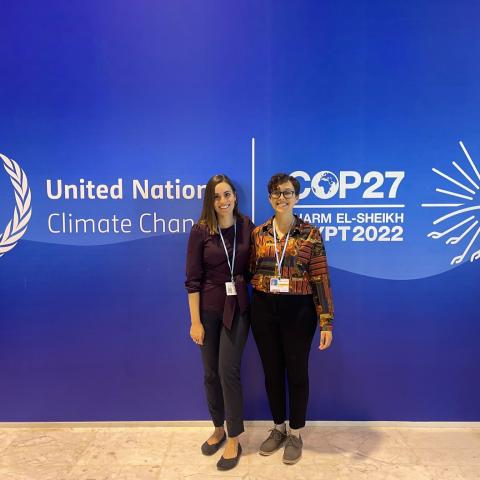
The Center for Policy Research on Energy and the Environment at Princeton University/SPIA is sending a delegation of students, researchers, and faculty to attend COP27 in Sharm el-Sheikh, Egypt from November 6-18. We will be hosting our second of two livestreams from Egypt on:
Environmental justice communities, those disproportionately affected by pollutants, are simultaneously exposed to multiple environmental stressors and also experience social and cultural factors that may heighten their health risks in comparison to other communities. Availability of fine-grained, community-level data is limited…
The Center for Policy Research on Energy and the Environment at Princeton University/SPIA is sending a delegation of students, researchers, and faculty to attend COP27 in Sharm el-Sheikh, Egypt from November 6-18. We will be hosting two livestreams from Egypt on:
During World War II, the Army hired women to hand-calculate ballistics trajectories for artillery firing tables. But these differential calculus equations took over 2 dozen hours by hand, and the Army needed thousands of them. In an attempt to speed up the calculations, the Army agreed to fund the creation of a truly…
Climate change is impacting biodiversity, ecosystem function, and human well-being. Regions with stable climates can act as climate refugia that will be critical to safeguarding climate-sensitive species. However, such refugia may only be “ecologically viable” if they are not heavily degraded by human activities. This talk…
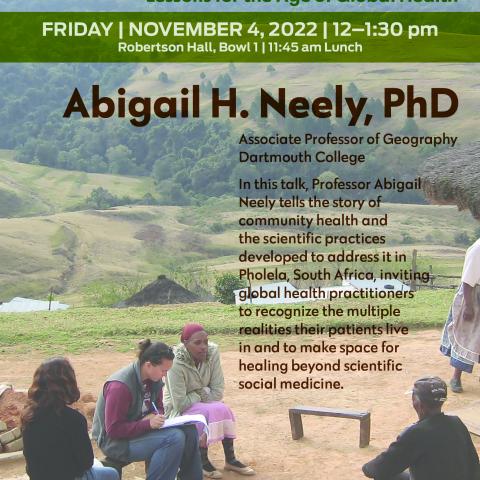
In this talk, Professor Abigail Neely tells the story of community health and the scientific practices developed to address it in Pholela, South Africa, inviting global health practitioners to recognize the multiple realities their patients live in and to make space for healing beyond scientific social medicine.
Frances Lee, Professor of Politics and Public Affairs, Princeton University
High Stakes Negotiation: Reaching Agreement on Pandemic Aid in 2020
Christopher Bertram, American University
Bettina Poirier, American University
The world needs to achieve net-zero greenhouse gas emissions by mid-century for a chance at limiting warming to less than 1.5°C. Last year, the Canadian government followed the lead of other nations and legislated a goal of net-zero by 2050. Achieving this goal requires shifting from incremental to transformational approaches…