Some software vulnerabilities are one-off bugs or typos in code. Others, however, are symptoms of deeper design flaws embedded in a system. As we increasingly confront harms across digital experiences, Wei argues that these harms are not anomalies, but canaries in a coal mine for systemic inequities. Synthesizing feminist…
Noah Zucker is an Assistant Professor of Politics at Princeton University, specializing in international and comparative political economy. He studies the political economy of climate change, with associated interests in bureaucracy, finance, identity, and labor. His work has appeared in the American Journal of Political…
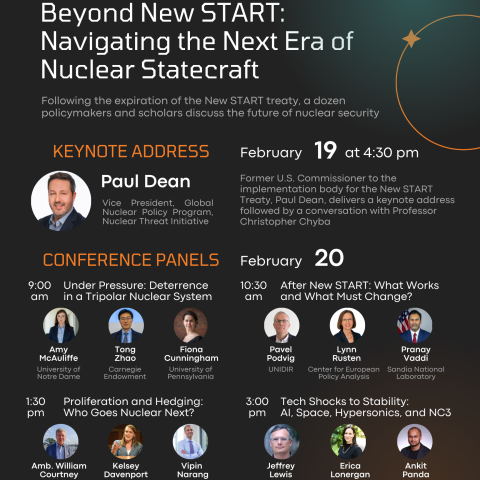
With the New START Treaty between the United States and Russia set to expire in February 2026 and no successor in sight, the world is sliding into a nuclear environment with degraded transparency, few limits on strategic offensive arms, and brittle crisis communications. Add the spread of rapidly evolving emerging technologies,…
In 2025, MrDeepfakes––long a central site for creating and trading AI-generated, non-consensual intimate images (NCII)––went offline. A week earlier, Congress passed S.126, the Take it Down Act, soon to become law. This bill makes publishing AI-generated NCII a federal crime and requires platforms to remove it within a strict…
Allison Carruth is a Professor in the Effron Center for the Study of America and the High Meadows Environmental Institute at Princeton, where she directs the Program in Environmental Studies. She is the co-founder and faculty director of Blue Lab and was the founding director of UCLA’s Lab for Environmental Narrative Strategies…
AI agents are increasingly performing consequential tasks autonomously: writing code, making purchases, and providing advice. But how do we know when to trust them? Current evaluation focuses predominantly on success rates: how often does the agent complete the task? This misses critical questions about how agents behave: Do…
In this talk, Weila Gong will present findings from her book, Implementing a Low-Carbon Future: Climate Leadership in Chinese Cities. Drawing on comparative case studies, process tracing, and over one hundred interviews with policy practitioners inside and outside the government, Gong opens the “black box” of subnational…