


Current Ph.D. Students
Profiles of Current Ph.D. Students

Keru is a Ph.D. student in the Science, Technology, and Environmental Policy program at the Princeton School of Public and International Affairs. She is advised by Dr. Wei Peng and Dr. Elke Weber. At Princeton, she hopes to study climate policy and energy system modeling with a focus on low-carbon transition pathways, decarbonization strategies, and the social dimensions of energy transitions. She is particularly interested in how public responses to climate policies shape policy evolution over time, and how feedback loops between policy design, social behavior, and public perception influence the effectiveness and political feasibility of energy transitions. Prior to Princeton, she earned dual degrees in mathematics and physics and environmental engineering from Tsinghua University. She also worked on decarbonization and clean energy transition projects at Maersk, and served as a research assistant at University of California, Berkeley and Stanford University.
Major Peter Loftus is an active-duty officer in the United States Air Force. He is currently a Chief of Staff of the Air Force Ph.D. Fellow at the Princeton School of Public and International Affairs (SPIA) where he is researching how great powers utilize the cyber domain in strategic competition. His advisor is Professor Naima Green-Riley. Since entering active duty almost a decade ago, he has deployed to Afghanistan, served in Korea, traveled across INDO-PACOM to support partnership efforts, and commanded a deployment with personnel from every branch of the U.S. military. Peter graduated magna cum laude from the University of Massachusetts Amherst with bachelor’s degrees in Chinese and Political Science. He also has a master’s degree from the Johns Hopkins School of Advanced International Studies (SAIS) where he concentrated in China Studies and International Economics. He has the Air Force’s top rating for China expertise and the service’s highest level for Mandarin proficiency. He spent two years in China between Project Global Officer scholarships, a Fulbright-Hays Grant, and graduate school. He has published in The Diplomat, the Air & Space Power Journal, and the Journal of Indo-Pacific Affairs.
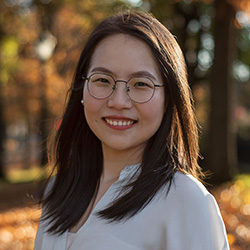
Jieyi is a Ph.D. student in the Science, Technology, and Environmental Policy (STEP) program at SPIA. She earned a bachelor’s degree in public relations from Sun Yat-sen University but was curious about environmental and energy issues. Driven by her curiosity, she obtained a master’s degree in public policy from Georgetown University studying environmental and energy policy and a master’s degree in environmental science from Yale University focusing on the impacts of air pollution on different groups of people. She also worked as a research assistant at Resources for the Future in Washington, D.C., conducting research related to China’s emissions trading system and applications of satellite data. At Princeton, she hopes to further investigate and develop solutions to improve both the environment and human wellbeing in the developing world.
Prior to attending Princeton, Jack graduated with a master's degree in environmental science from Yale School of the Environment. His master's thesis examines the Chilean Constitutional Convention of 2022, considers its environmental justice implications, and addresses the rejection of the proposed constitution. Jack graduated summa cum laude with a Bachelor of Science from Furman University, where he majored in sustainability science and Spanish language and literature, with a minor in Latin American and LatinX studies. His undergraduate thesis maps ecosystem services geographically and examines policy mechanisms that contribute to differing levels of ecosystem service provisioning. He has additionally earned an Associate of Arts from Greenville Technical College. At Princeton, Jack will continue to research environmental justice policy and compare policies from various international contexts.
Before coming to Princeton SPIA, Zoe spent nearly a decade working at the intersection of technology, data science, and public policy. Most recently, she served as Research Manager at the Tech Council of Australia, leading quantitative research on technology policy, productivity, innovation, and workforce development. She also worked as a Data Science Consultant for the World Bank Group, building data visualization tools for economists and policy specialists. Prior to that, Zoe spent four years as a Data Scientist at Canva, helping scale products used by hundreds of millions of people worldwide. Earlier in her career, she conducted public policy research at the University of Sydney’s United States Studies Centre, analyzed political surveys, published research on technology and public opinion, and completed a Google News Lab fellowship with ABC News. Outside of work, she maintains open-source software used by governments, journalists, and researchers around the world and remains convinced that every problem can be improved with a well-designed chart. At SPIA, she plans to focus on technology policy, artificial intelligence, misinformation, and the governance of emerging technologies.