

A quiet revolution is reshaping how money moves. Across the Global South, governments are building public digital payment systems — India’s UPI, Brazil’s Pix, and a growing number of real-time cross-border corridors — that challenge longstanding assumptions about who controls the infrastructure of global finance.
This talk examines two dimensions of that transformation. The first is geopolitical. The United States has long exercised dominance not only through the dollar but through the rails beneath it — SWIFT, correspondent banking, the global reach of Visa and Mastercard. Washington has repeatedly leveraged this infrastructure for its strategic ends. While many in Washington are concerned about de-dollarization, we focus on the construction of alternative rails that reduce dependence on U.S.-controlled systems. We explore whether this “rail dominance” of the U.S. financial system will prove as strategically significant as currency dominance — and what U.S. policy is failing to reckon with.
The second is innovation. Proponents of digital public infrastructure argue that open, interoperable rails generate innovation by enabling private experimentation atop a publicly maintained core. But that is too simplistic a narrative. UPI’s design choices around interoperability and zero-fee pricing accelerated adoption but also compressed margins, concentrated market share, and blurred the line between infrastructure governance and platform innovation. The result challenges the foundational DPI slogan of “public rails, private innovation” — and raises hard questions about where returns to investment are supposed to come from as these systems scale.
Both strands point to a common insight: the design of payment infrastructure is simultaneously a technical, economic, and political act, with consequences that extend well beyond the movement of money. We share our thoughts about these questions here: https://digitalrails.substack.com/.
Bios:
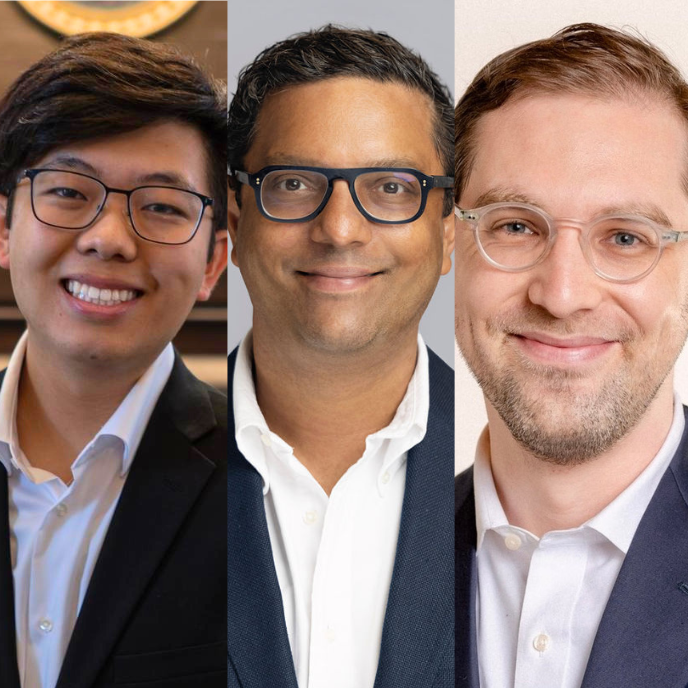
Felix Chen is a researcher interested in examining societal impacts of artificial intelligence, technology-enabled access to justice, and digital public infrastructure. Previously, as a volunteer for the Massachusetts Small Claims Advisory Service, Chen developed technical tools aimed at improving public access to legal information. He received an A.B. in computer science and government from Harvard College, where his undergraduate thesis analyzed municipal data practices and their effects on constituent trust.
Mihir Kshirsagar runs CITP’s first-of-its-kind interdisciplinary technology policy clinic that gives students and scholars an opportunity to engage directly in the policy process. Most recently, he served in the New York Attorney General’s Bureau of Internet & Technology as the lead trial counsel in cutting edge matters concerning consumer protection law and technology and obtained one of the largest consumer payouts in the State’s history. Previously, he worked for Cravath, Swaine & Moore LLP and Cahill Gordon Reindel LLP in New York City on a variety of antitrust, securities and commercial disputes involving emerging and traditional industries. Before law school he was a policy analyst at the Electronic Privacy Information Center in Washington, D.C., educating policy makers about the civil liberties implications of new surveillance technologies. Kshirsagar attended Deep Springs College and received an A.B. from Harvard College in 2000 and a law degree from the University of Pennsylvania in 2006.
Jeremy McKey is a tech policy researcher at CITP and a policy fellow at Harvard Kennedy School’s Allen Lab. Previously, he was Director of Special Projects at the Rockefeller Brothers Fund, where he led a funding initiative focused on U.S. democracy. His interest in DPI emerged while pursuing an MPA degree, where he had the chance to spend several months in New Delhi researching the India Stack. He is particularly interested in the geopolitics of DPI payment systems, as well as the ways that DPI can contribute to a vision of democratic renovation. McKey has an undergraduate degree from the University of Chicago and his Master’s degree from Princeton University.
In-person attendance is open to Princeton University faculty, staff and students.
This talk will not be livestreamed or recorded.
If you need an accommodation for a disability please contact Jean Butcher at butcher@princeton.edu.
Sponsorship of an event does not constitute institutional endorsement of external speakers or views presented.