
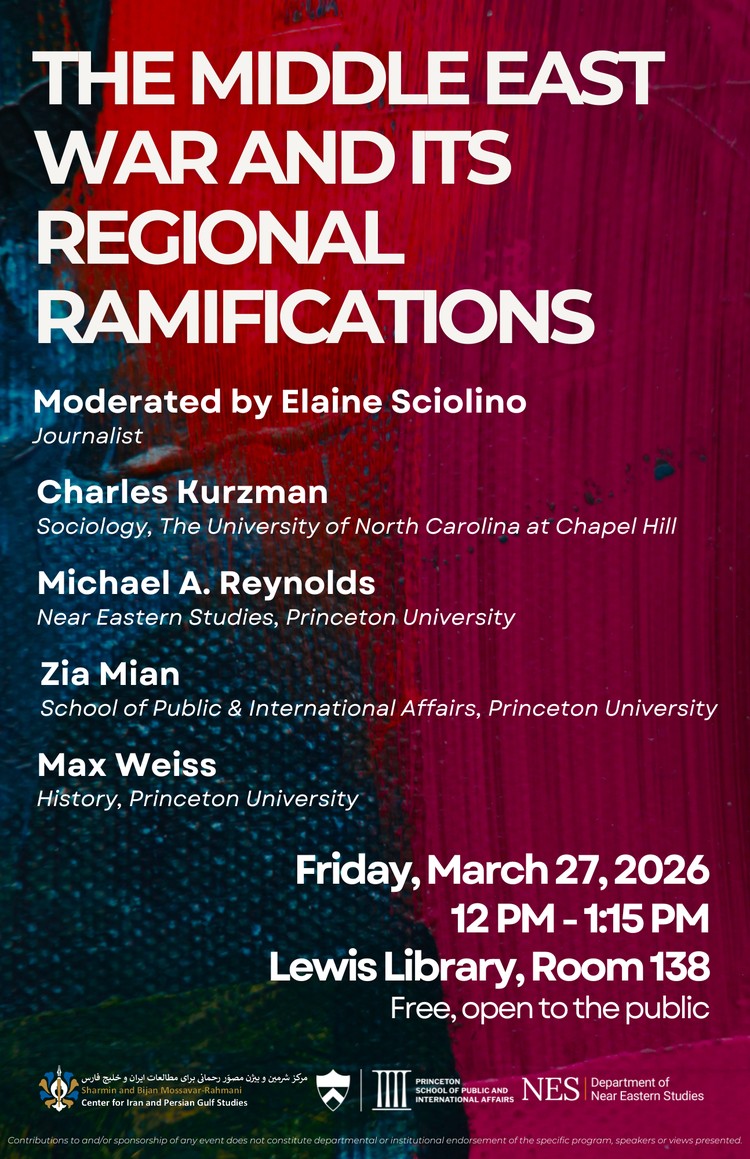
Elaine Sciolino, Journalist; Moderator
The first American and the first woman journalist to interview Ayatollah Ruhollah Khomeini in Paris and Ayatollah Ali Khamenei in Iran, she covered the Iranian revolution, the hostage crisis, the Iran--Iraq war from both sides of the border, and Iran's nuclear program. From 2015 to 2017, she was the guest lecturer on six New York Times-led tours to Iran.
Her book, Persian Mirrors: The Elusive Face of Iran, was awarded the New York Public Library Helen Bernstein Book Award for Excellence in Journalism and the Overseas Press Club Cornelius Ryan Citation for nonfiction. It was a History Book Club selection and a New York Times Notable Book for 2000. During the Persian Mirrors project, she received fellowships from the United States Institute of Peace, the Woodrow Wilson International Center for Scholars, and the Open Society Institute.
Charles Kurzman, Sociology, The University of North Carolina at Chapel Hill
Charles Kurzman is a professor of sociology at the University of North Carolina at Chapel Hill. He is author of The Missing Martyrs (first edition, 2011; second edition, 2019); Democracy Denied, 1905–1915 (2008); and The Unthinkable Revolution in Iran (2004). He is editor of the anthologies Liberal Islam (1998) and Modernist Islam, 1840–1940 (2002). He is a long-time trustee of the American Institute for Iranian Studies, and his research on Iran has been cited in the New York Times, Washington Post, and numerous publications in Iran.
Michael A. Reynolds, Near Eastern Studies, Princeton University
Michael A. Reynolds is associate professor of Near Eastern Studies at Princeton University. He is the author of Shattering Empires: The Clash and Collapse of the Ottoman and Russian Empires (Cambridge: Cambridge University Press, 2011), co-winner of the American Historical Association’s George Louis Beer Prize, a Financial Times book of the summer, and a Choice outstanding title. His research areas include Ottoman and modern Middle Eastern history, Russian and Eurasian history, the Caucasus, international relations, empire, nationalism, Turkish foreign policy, and US foreign policy. He holds a BA in Government and Slavic Languages and Literature from Harvard University, an MA in Political Science from Columbia University, and PhD in Near Eastern Studies from Princeton University.
Zia Mian, Program on Science and Global Security, Princeton University
Zia Mian is a physicist and co-director of Princeton University's Program on Science and Global Security (SGS), part of the School of Public and International Affairs, where he has worked since 1997. His research interests include nuclear arms control, nonproliferation, disarmament, and global peace, justice, and security. Mian serves as Co-Chair of the Scientific Advisory Group of the United Nations Treaty on the Prohibition of Nuclear Weapons. Established in 2023, the Scientific Advisory Group is the first international scientific body created by a United Nations treaty process for the purpose of advancing nuclear disarmament. In 2022, Mian was appointed to the UN Secretary-General’s Advisory Board on Disarmament Matters. It advises the UN Secretary-General on matters concerning arms limitation and disarmament, including studies and research. He has been working on nuclear issues in Iran and the broader Middle East and the scope for a nuclear-weapon-free zone in the Middle East for over a decade, including advising the annual UN Conference on the Establishment of a Middle East Zone Free of Nuclear Weapons and Other Weapons of Mass Destruction. He served on the Editorial Committee of the Middle East Research and Information Project from 2009-2014.
Max Weiss, History, Princeton University
Max Weiss studies the cultural, intellectual, and literary history of the modern Middle East, and is Associated Faculty in Comparative Literature. He is the author of Revolutions Aesthetic: A Cultural History of Baʿthist Syria (Stanford UP, 2022), and In the Shadow of Sectarianism: Law, Shiʿism, and the Making of Modern Lebanon (Harvard UP, 2010); co-editor (with Jens Hanssen) of Arabic Thought Beyond the Liberal Age: Towards an Intellectual History of the Nahda (Cambridge UP, 2016), and Arabic Thought Against the Authoritarian Age: Towards an Intellectual History of the Present (Cambridge UP, 2018); and translator, most recently, of Alawiya Sobh, This Thing Called Love (Calcutta, 2022); Dunya Mikhail, The Beekeeper: Rescuing the Stolen Women of Iraq (New York, 2018), and Nihad Sirees, States of Passion (London, 2018). He earned a Ph.D. in Modern Middle East History from Stanford University, held postdoctoral fellowships at Princeton University and the Harvard Society of Fellows, and his research has been supported by the Fulbright-Hays Commission, the Social Science Research Council, and the Carnegie Corporation.
- Department of Near Eastern Studies (NES)
- School of Public and International Affairs (SPIA)
Sponsorship of an event does not constitute institutional endorsement of external speakers or views presented.