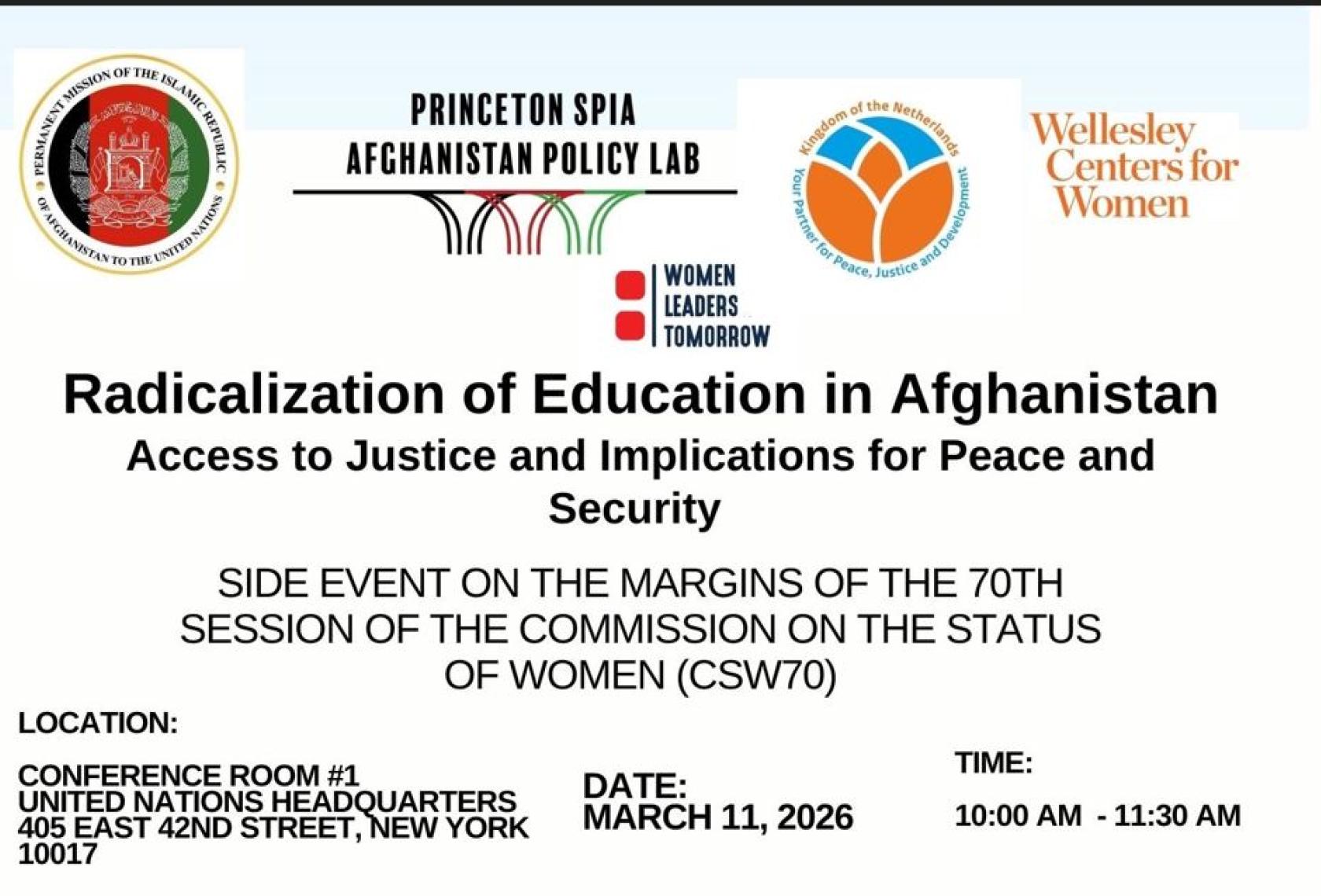

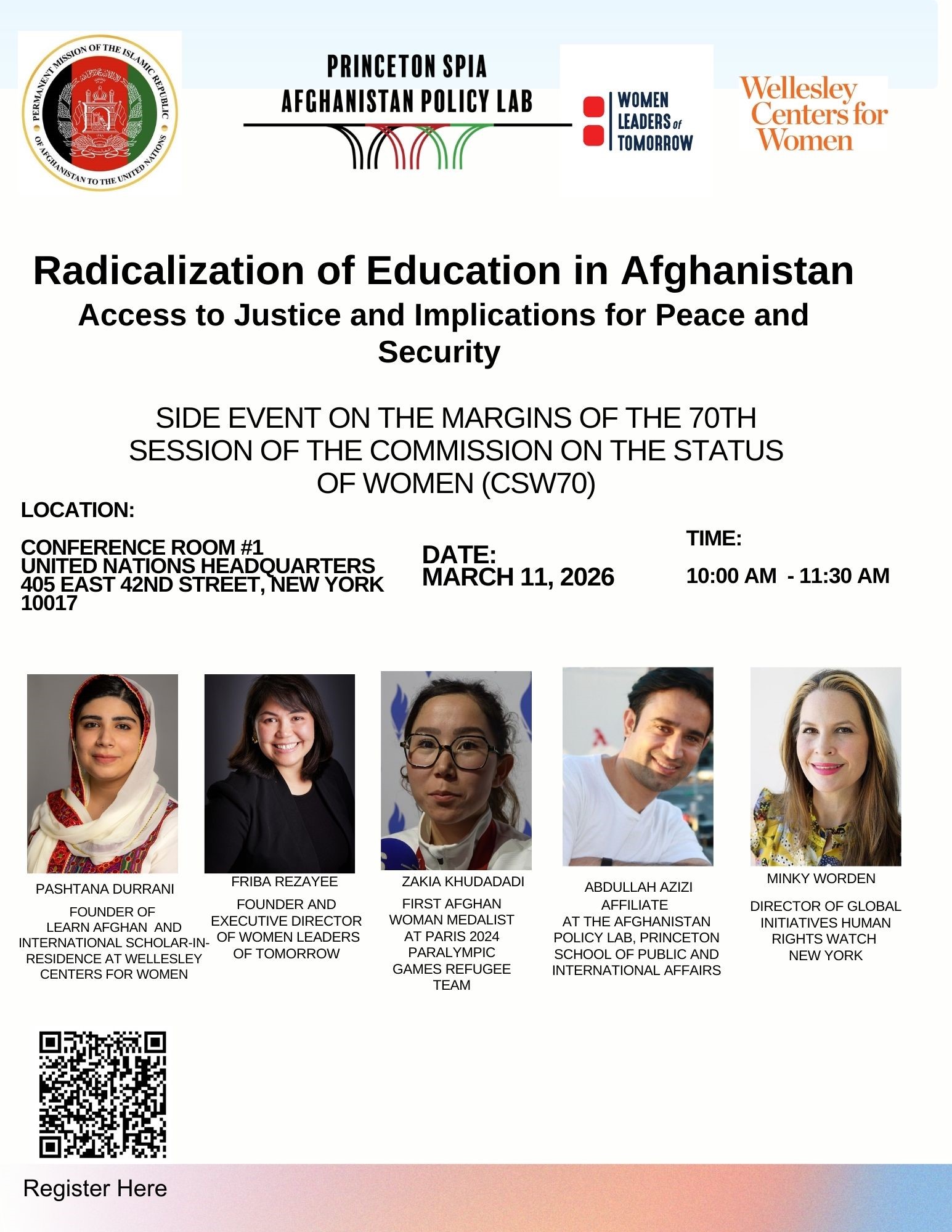
The 70th session of the Commission on the Status of Women (CSW70) is guided by the priority theme of ensuring and strengthening access to justice for all women and girls, including through inclusive and equitable legal systems, the elimination of discriminatory laws, policies, and practices, and the removal of structural barriers. The review theme further emphasizes women's full and effective participation in public life and decision-making, as well as the elimination of violence against women and girls, in line with the Beijing Declaration and Platform for Action.
Within this framework, the situation of women and girls in Afghanistan represents one of the gravest contemporary violations of access to justice, legal equality, and the Women, Peace and Security (WPS) agenda. Since August 2021, the Taliban authorities have imposed a system of institutionalized gender-based discrimination that systematically excludes women and girls from education, employment, public life, sports and recreation, and legal protection. These policies not only violate international human rights law but also undermine peace, social cohesion, and long-term security by entrenching exclusion and radicalization.
Central to this system is the radicalization of education. Approximately 2.2 million adolescent girls are barred from secondary education, making Afghanistan the only country in the world with a nationwide ban on girls' secondary and higher education. In parallel, the Taliban authorities have expanded religious madrassas as alternative educational structures, even as formal education opportunities for girls have disappeared. This deliberate shift replaces modern education with ideologically controlled systems that restrict critical thinking, institutionalize gender segregation, and normalize discriminatory interpretations of religion—posing long-term risks to peace and security.
The systematic exclusion of women educators has further weakened Afghanistan's education and professional infrastructure, eliminating women's leadership in learning spaces and eroding pathways to economic participation. The denial of education for girls and women has profound generational consequences, contributing to poverty, social instability, and cycles of exclusion that directly contradict WPS commitments on prevention, participation, and protection.
In this context, online and digital education has emerged as one of the few remaining pathways for Afghan women and girls to access learning, both inside the country and in exile. While Afghan women have demonstrated resilience through informal digital initiatives, these efforts remain fragmented, under-resourced, and unsupported by coordinated international frameworks.
At the same time, the global economy is undergoing rapid transformation driven by digitalization, artificial intelligence (AI), and the Fourth Industrial Revolution. Excluding Afghan women from technology-enabled education not only deepens injustice but also systematically prevents their participation in future labor markets, digital economies, and peace-building processes that increasingly transcend borders.
This side event will examine how the radicalization of education in Afghanistan constitutes a denial of access to justice, a violation of the Beijing Platform for Action, the 2030 Agenda, and the WPS framework, and a direct threat to long-term peace and security. It will also explore how ethical, gender-responsive online education and responsible integration of AI can serve as justice-enabling tools, supporting women's empowerment, economic resilience, and long-term inclusion in a technology-driven global economy.
Objectives
- To analyze how the expansion of madrassas and curriculum changes entrenches gender discrimination, ideological control, and risks to peace and security under the WPS agenda.
- To assess nationwide curriculum changes and the removal of modern, rights-based education, and their implications for girls' education, critical thinking, civic engagement, and women's empowerment.
- To present alternative education pathways for Afghan women and girls aligned with international standards, including community-based and digital learning models.
- To assess the long-term implications of these policies for Afghan youth, social cohesion, intergenerational justice, and sustainable peace.
- To explore how digital literacy, AI competencies, and online work readiness can advance economic empowerment, justice, and women's meaningful participation in peace-building.
- To identify legal, policy, and accountability pathways for Member States and the international community to respond, consistent with Beijing+30 commitments.
Speakers and Moderator
Sponsorship of an event does not constitute institutional endorsement of external speakers or views presented.