


Current Students
Biographical Profiles of Current MPA Graduate Students
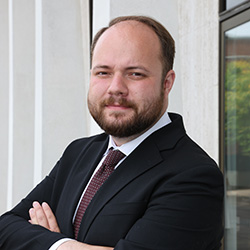
Originally from Tukwila, Washington, Benton graduated with a degree in economics from the University of Washington in Seattle. During his undergraduate years, Benton focused his studies on the transition from communism and studied abroad in Georgia, Romania, and Russia. After graduation, he worked in local economic development, first for the City of Tukwila and then for the City of Issaquah, where he assisted in the city's response to the COVID-19 pandemic. He was an active contributor to his community, sitting on the boards of several local community organizations, including as board chair of the Tukwila Pantry, the local food bank in his community. After Russia's full-scale invasion of Ukraine, Benton went to work for the Atlantic Council's Eurasia Center, where he facilitated the Center’s work on Ukraine and the wider Eurasia region and actively contributed to the Atlantic Council’s UkraineAlert and New Atlanticist blogs. His plan after graduation from Princeton SPIA is to continue his work on U.S. policy toward Eurasia and in support of Ukraine.
Born and raised in Israel, Ofir has been acutely aware of the Israeli-Palestinian conflict over the years and works to bridge the gaps. He enjoyed working as a manager at the consulting firm 'DNAidea' and has a strong background in policymaking, research and analysis. Passionate for creating an impact, Ofir thrives on diverse projects involving strategic consulting and methodology development across various sectors, including support for youth at risk, prisoner rehabilitation among the underserved Bedouin population in Israel, and designing a fair path to Israeli citizenship. Ofir has a triple degree in Law, Economics, and Philosophy, which he obtained prior to arriving at Princeton as part of an exclusive program for outstanding students at Hebrew University. During his graduate studies, Ofir interned in the U.S. Congress, where he supported legislative research and policy analysis on technology, national security, and foreign affairs. In this role, he drafted background memos, contributed to hearings preparation, and engaged with bipartisan staff to assess the policy implications of emerging technologies. This experience provided him with first-hand exposure to the American legislative process and deepened his ability to navigate complex political environments at the intersection of law, policy, and strategy. He aspires to change the nature of political arguments from political polarization to passionate yet respectful discussions in the political sphere and to build bridges between people from different sides of political aisles, to work together to a better future for everybody. In his free time, Ofir enjoys spending time with his wife and daughter, reading, and practicing calisthenic exercises.
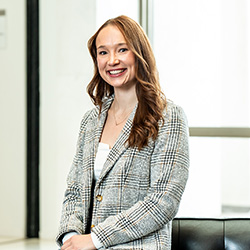
Hope comes to SPIA after four years at the Federal Bureau of Investigation, including a one-year appointment to the White House National Security Council. Originally from Palo Alto, Hope joined the FBI at their Washington, D.C., field office where she aided special agents in strategic analysis, facilitation of intelligence sharing and training, and administrative management. Hope was promoted to Staff Operations/Tactical Analyst in the Counterterrorism Division, which required an intensive, residential training at Quantico. After graduation from Quantico, her work focused on national threat priority portfolios. During her tenure representing the FBI at the White House National Security Council, Hope collaborated with the highest levels of national security professionals to address complex security dynamics and implement rapid policy developments. She supported the President’s diplomatic objectives as a member of the Presidential delegation, both in France for the commemoration of the anniversary of Normandy, and at the United Nations General Assembly. Prior to her professional career, Hope earned her Bachelor’s degree at the University of North Carolina. She then returned to her hometown in the Bay Area to care for her grandmother. While there, she held multiple jobs in her church's leadership, creating community-informed programming to foster a caring and inclusive space during the tumult of the COVID-19 pandemic. Once Hope earns her MPA from SPIA, she looks forward to returning to public service to address federal domestic policy challenges. In her free time, Hope enjoys exploring National Parks, finding a new coffee shop or library, and baking sweet treats.
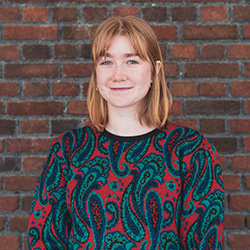
Mera believes that U.S. social policy should equitably reflect the social contract we have to one another. In practice, this means she wants to ensure that social policy is informed by rigorous evidence developed in partnership with New American communities. As a Senior Policy Associate at J-PAL North America, she assisted U.S. states and localities in developing rigorous evidence to inform social policy. Mera also communicated extensively about the important role of researcher-practitioner partnerships in evidence-based policymaking and led an initiative exploring the role of community engagement and participatory research in government-led evaluation work. Mera holds a B.S. from The Ohio State University, where she studied economics and Russian with a minor in consumer and family financial services. Before joining J-PAL, Mera interned for a financial planning firm in Central Ohio. She also worked with a Central Ohio refugee resettlement agency and served as a long-term mentor in their youth program.
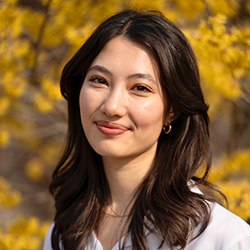
Born and raised in New York City, Caroline Crystal graduated with a B.A. in Global Affairs and History from Yale University. After a yearlong fellowship in the Democracy, Conflict, and Governance Program at the Carnegie Endowment for International Peace, Caroline spent two years at the primary implementing partner for the State Department’s Conflict Observatory Program using open-source information and satellite imagery analysis to document potential violations of international law and to support humanitarian field teams in Ukraine and Sudan. Most recently, Caroline worked for the DEVELOP National Program at NASA’s Ames Research Center, where she used earth observations to monitor air pollution and associated public health outcomes, and she is currently a NASA Lifelines Fellow. Outside of the classroom, Caroline enjoys morning park walks, science and nature podcasts, and trying to cook new foods.