


Current Students
Biographical Profiles of Current MPA Graduate Students
Judah comes to SPIA as a Scholars in the Nation’s Service Initiative (SINSI) Graduate Fellow, bringing a unique blend of technology, international relations, and community leadership. Before SPIA, he earned a Bachelor of Science in Engineering in Computer Science from Princeton, where he also pursued certificates including History and the Practice of Diplomacy, Near Eastern Studies, and Cognitive Science. His academic journey included a year at Yeshivat Ma’ale Gilboa in Israel, where he deepened his commitment to text-based learning, thoughtful dialogue, and moral reasoning. Judah’s professional background spans government, technology, and nonprofit leadership. He founded and directed Shalshelet Shivyoni, a national nonprofit dedicated to creating inclusive and egalitarian Jewish communities across college campuses. He served as a deployment strategist at Palantir Technologies, helping government agencies develop data-driven solutions. He also gained policy experience interning for U.S. Congressman Lou Correa (D-CA) and worked as a counselor for the Bronfman Fellowship in Jerusalem, mentoring students through transformative experiences. At Princeton, Judah was active in student government, Mock Trial, and the Interfaith Religious Life Council, developing his skills in diplomacy, negotiation, and advocacy. Now at SPIA, he is excited to integrate these experiences through the SINSI Fellowship, with aspirations of a career in public service that leverages his technical background to address complex policy challenges. Outside the classroom, Judah enjoys hiking, running, and exploring new places.
Sophia was born and raised in El Salvador and finished high school in Dallas, Texas. She was a Forty Acres Scholar at the University of Texas at Austin where she focused on Latin America, international political economy, and natural resource management. Sophia engaged in faculty research projects on democracy in Texas and beyond while balancing community engagement in service organizations including a refugee awareness group and UT’s oldest women’s honorary service society. Sophia then worked with Ernst and Young as an anti-money laundering and regulatory compliance analyst. Once the COVID-19 pandemic subsided, Sophia lived and worked in Paraguay for almost three years, serving as an environmental education Peace Corps Volunteer. During her service, she worked closely with high school teachers at her rural site, developing and delivering tailored lessons and programs, including interdisciplinary permaculture garden projects. She extended her service by almost six months to work closely with a local sustainable development organization and to continue providing support to fellow PCVs. Sophia is passionate about sustainable development, environmental governance, and climate-forward strategies applied in the Latin American context. After SPIA, she plans to pursue meaningful work in these fields while fostering strong community connections. Sophia enjoys gardening, cooking, making things with her hands, and spending time with friends in nature.
Allen is a joint MPA/J.D. candidate who has focused his career on working in government at the confluence of technology, national security, and American competitiveness. He was most recently at the State Department, where he served as an analyst in the Bureau for International Security and Nonproliferation. In that role, he worked to preserve and extend U.S. leadership in critical technologies by supporting the development of export controls on semiconductors and AI and negotiations with partner countries on aligning critical technology protections. Allen previously served as a policy advisor in the White House Office of Science and Technology Policy, where he supported development of the Biden Administration’s Executive Order on AI, coordinated biotechnology policy initiatives, and managed implementation of provisions in the CHIPS and Science Act and Inflation Reduction Act. He joined the civil service after college, working at the General Services Administration’s Technology Modernization Fund to strengthen the federal government’s technology infrastructure in response to the COVID-19 pandemic and emerging cybersecurity threats. Born and raised in central Connecticut, Allen attended the University of Oxford, where he completed a B.A. in Philosophy, Politics, and Economics with First Class Honors in 2020. Allen enjoys hosting dinner parties, cycling, constructing crossword puzzles, and taking long train rides.
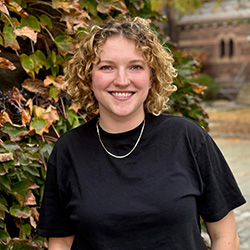
Julia was born and raised in Pennington, New Jersey, and is excited to be returning to her beloved home state. In 2019, she graduated from the University of Virginia with a degree in economics and since then worked at the Congressional Budget Office (CBO) in the Labor, Income Security, and Long‐Term Analysis Division. At CBO, she worked on estimating the labor market effects of a proposed policy to raise the minimum wage and modeling the economic effects of immigration. After Princeton, she hopes to pursue a law degree and use her quantitative background to enact criminal justice reform. This summer, she had the opportunity to intern at the ACLU's National Policy Advocacy Division on the Justice Team. There, she worked on researching and drafting legislative proposals, developed policy options, and conducted a cost-benefit analysis on a piece of proposed legislation.
Mackenzie is a democracy and governance professional with seven years of experience working to strengthen the capacities of election management bodies, political party leaders, members of parliament and county assemblies, and civil society organizations across Southern and East Africa. Originally from St. Louis, Missouri, she received a B.A. in Peace and Justice Studies with a minor in Africana Studies from Wellesley College. Following graduation, she moved to Washington, D.C., where she spent over three years working on the National Democratic Institute’s Southern and East Africa team and contributing to institutional initiatives. During the early days of the pandemic, Mackenzie moved to Addis Ababa, Ethiopia, with the International Foundation for Electoral Systems (IFES), where she spent two years providing direct technical support to the National Election Board of Ethiopia and implementing peace and conflict resolution programs. Most recently, she managed IFES’ Africa programs in Kenya, Tanzania, and Zambia from the headquarters office in the Washington metropolitan area. When not thinking about democratic resilience, she can be found learning new languages, enjoying water sports of any kind, and attending as many musicals, plays, and ballets as time allows.