We use the term “justice” in many climate contexts (e.g. “just transition”)—and indeed in a variety of other political and policy contexts (e.g. “social justice”). What does it mean? In this talk, I break down some common forms of justice from a philosophical point of view in order to inform climate science and policy. The goal…
Valerie Mueller received her Ph.D. in Agricultural and Resource Economics at the University of Maryland. She is currently an Associate Professor in the School of Politics and Global Studies at Arizona State University (ASU).
Climate change is changing the characteristic of weather extremes and slow changing climatic trends (physical climate risk). These combined with rising concentration of people and assets in high-risk areas, aging infrastructure and various macroeconomic factors, are leading to growing financial impacts on people, businesses,…
Frances C. Moore is an Associate Professor in the Department of Environmental Science and Policy and the University of California Davis. She studies the risks climate change poses to human welfare and how individuals and communities respond to mitigate those risks. Her work is highly interdisciplinary with a focus on climate…
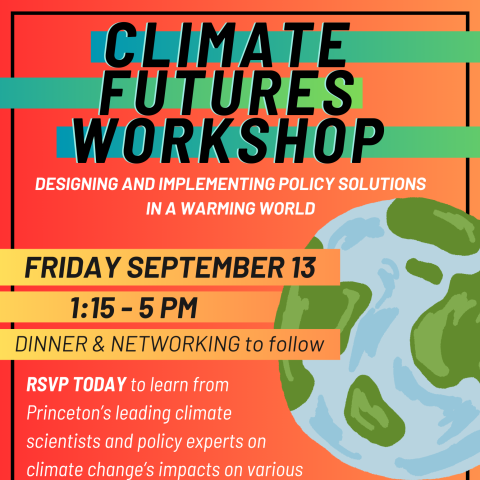
Join us for an afternoon workshop to introduce new and returning students and researchers to the wealth of experts at Princeton University working on environmental policy issues. Open to all with beginner to expert-level knowledge of climate change science and policy! This workshop will help you consider the intersectional and…
Efforts to achieve decarbonization targets often fall short. Energy system modeling based on integrated assessment models (IAMs) has been used widely to assess current climate policies and quantify the additional efforts needed to close the gap. Yet, most energy modeling still lacks adequate considerations of socio-political…