


Over the last year, a senior at the Princeton School of Public and International Affairs developed an economic model to show that advertising-based digital apps drive addictive behavior. Another traveled to northern Norway to learn about changes in the Arctic from the indigenous Sámi people.
One student spent her summer in Los Angeles at an air-conditioning, plumbing, and electrical company to develop an apprenticeship program, while another interviewed more than three dozen healthcare providers across the country about child welfare reforms for substance use in pregnancy.
All in the name of the senior thesis.
The senior thesis is the culminating accomplishment of Princeton undergraduate students. Many students enter their senior year having formulated a topic — sometimes based on a lifelong interest, other times from a spark discovered during one of their courses — and they spend the academic year working closely with a faculty member to refine, research, and write that seminal paper.
Often more than 100 pages, the thesis has a life of its own: It’s submitted to the university library, where it remains long after students have received their diplomas and moved out of their dorms. Go on to accomplish something big in your career, and chances are someone will dig up your Princeton thesis and republish it.
But the thesis is not merely for the archives. Alex Hunter ’23 recently drafted a motion for the Canadian Parliament based on a policy proposal in his senior thesis. The motion calls for the creation of a national strategy on mental health response following emergencies such as natural disasters and mass casualty events.

Princeton SPIA alumnus Wendy Kopp ’89 — this year’s Class Day speaker — laid the groundwork for Teach for America in hers. Alyssa Lloyd ’26 said she was inspired by Kopp to write a thesis that is actionable.
“She had this idea of bridging two problems: undergrads who were leaving college with a degree, but not necessarily finding jobs right away, and under-resourced school districts,” Lloyd said. “I felt like I could maybe do something similar with transitioning foster youth and the skilled labor shortage in our country.”
Lloyd’s thesis reviews the feasibility of an apprenticeship program for young adults aging out of the foster care system. She and her classmates developed the idea in a policy entrepreneurship class during her junior year, and Lloyd spent the following summer at Apex Service Partners in Los Angeles to explore the logistics of launching such a program at a home service company.
Over the next year, Lloyd will get a chance to implement what she has learned. As one of four recipients of a Princeton ReachOut fellowship, she will work with a Seattle nonprofit to build out programming and employment pathways for a youth transitional living facility.
Cumulatively, this year’s Princeton SPIA theses — 135 in total — represent an expansive review of the current policy landscape and demonstrate the breadth of policy issues that matter in this moment, including biofuels, cryptocurrency, municipal identification, terrorist financing, citizenship, decarbonization, Middle East conflicts, the Russia-Ukraine war, transatlantic security, child welfare, data centers, arts grant funding, school voucher programs, physician shortages, Native American sovereignty, and, of course, artificial intelligence. This year’s projects explore the role AI plays in education, national security, authorship, workforce training, radiology, and even domestic violence.
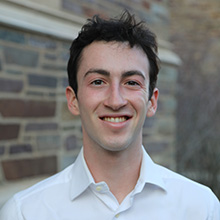
Sander McComiskey ’26 said the thesis taught him how to tackle a large, conceptually difficult policy problem over time as well as make a narrow, definite contribution to a particular subfield of academic literature.
"It’s an important skill to develop, especially if you want to keep working in the intersection of policymaking and ideation about policy,” he said.
Inspired to focus on tech policy by his junior-year Policy Advocacy Clinic experience and on digital attention markets by a philosophy book he read, McComiskey set out to demonstrate that ad-driven business models incentivize developers to make digital apps addictive. He achieved that by building an original economic model, then tested its implications against survey data and made policy recommendations.
“Few senior theses attempt that range, and fewer pull it off. The result is a serious contribution to how we should think about digital technology and attention — and to what we might do about it,” said Mihir Kshirsagar, McComiskey’s thesis adviser and a Princeton SPIA lecturer.

Thesis advisers have a front-row seat to the students’ efforts and help steer them toward creating something with impact. Heather Howard, a professor of the practice at Princeton SPIA, advised Hannah Gabelnick ’26 on her thesis about child welfare reforms that can help pregnant women with substance use disorder obtain treatment without the threat of losing their children. Gabelnick interviewed 38 healthcare providers and state agency officials, focusing on four states at varying stages of reform implementation, to identify best practices.
“Not only is it methodologically rigorous, but it’s incredibly policy-relevant,” Howard said of Gabelnick’s thesis, adding that it has “the potential to inform ongoing reforms efforts in other states.”
Gabelnick, who will be a Garden State Fellow with SPIA in NJ after graduating, said she hopes to continue working on maternal and reproductive health issues throughout her career.
“I’ve definitely learned that change takes a long time,” she said, “and you need people who are really dedicated.”
Photo credit (top): Andrea Kane