



Elke Weber, a professor of psychology and public affairs and the Gerhard R. Andlinger Professor in Energy & the Environment, was the recipient of the 2025 I.N.S.P.I.R.E. Award from HEC Lausanne.
Presented by the business school of the University of Lausanne in Switzerland since 2018, the I.N.S.P.I.R.E. award (“INspiring Success: Promoting Inclusion, Research, and Excellence”) recognizes “a researcher within the international academic community whose exemplary career inspires the next generation and encourages women's careers in academia,” according to the university’s story about Weber’s selection.
Weber’s research focuses on psychologically appropriate ways to measure and model individual and cultural differences in risk taking, specifically in risky financial situations and environmental decision making and policy.
“Elke Weber perfectly embodies the spirit of the award: a world-class researcher whose work crosses disciplinary boundaries and deeply inspires our academic community,” said Julian Marewski, director of the department of organizational behavior at HEC Lausanne.
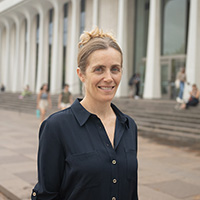
Pascaline Dupas, a professor of economics and public affairs, was named to Vox’s 2025 Future Perfect 25 list — “a group of innovators, thinkers, disruptors, and people on the ground who are advancing solutions for the most pressing challenges in global health and development.”
Cited as an “accomplished economist dedicated to reducing global poverty,” Dupas through her research has influenced British foreign aid, government policy in African countries, the World Health Organization, NGOs, and global health practitioners.
Over the past year, Dupas has focused her research on West Africa, analyzing early childhood health development. At Princeton SPIA, Dupas directs the Center for Health and Wellbeing.
“It obviously takes more than 25 people to make the future perfect, so I, just like everyone else on the list, stand as the tip of the iceberg,” Dupas said. “I am part of a vast effort by development economists to help advance evidence-informed policymaking in lower-income countries. I have been really impressed and encouraged by the policy partners we have been working with, their appetite for evidence and willingness to adapt and pilot policies in their local contexts.”
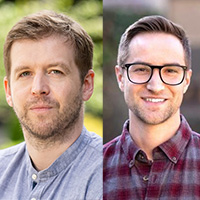
Ryan Manzuk and Igor Moric, researchers at the Program on Science and Global Security, have been selected for the Museum of Science’s inaugural Science Communication Fellowship. This first-of-its-kind six-month science communication fellowship is designed to help scientists, researchers, and content creators bring science to the public. Fellows will be paired with established digital communicators to co-create engaging, innovative, and impactful science content and will participate in a multi-week training and speaker series to equip them with diverse approaches to modern communication. All submissions will be featured in the Museum of Science’s first ever science communication conference.
“We are both honored to be accepted into to Museum of Science fellowship,” the pair said. “It offers a unique opportunity to gain experience communicating concepts from our work to a broad, curious audience. We’re looking forward to what we will create alongside our mentors and using this communication experience in our careers moving forward.”
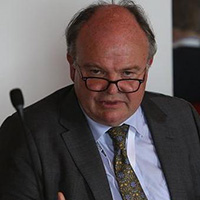
Wolfgang Danspeckgruber’s Global Food and Water Security Project was featured in a documentary as part of the Thought Leadership Film Series, a component of CGIAR’s “With Science We Can” campaign. The documentary, “Scars of War, Seeds of Hope,” premiered at COP30 in Belém, Brazil, on November 13.
Led by Danspeckgruber, the founding director of the Liechtenstein Institute on Self-Determination, the Global Food and Water Security Project (GFWS) is a pioneering international, interdisciplinary, and intergenerational initiative addressing one of the most urgent global challenges: the environmental and potentially generational human health consequences of armed conflict. The effects of conflict and warfare on water and soil can have generational effects due to poisoning, pollution, and contamination of land and water and concomitant health effects, particularly for mothers and babies. The longer these effects of war and conflict remain untreated, the more they compound, and the more widespread their implications for health and the environment.
GFWS aims to generate actionable insights to inform farmers, policy, and decision makers, guide humanitarian responses, develop effective decontamination and remediation strategies, support sustainable recovery in conflict-affected regions, educate, and raise global awareness about the long-term relationship between conflict, environment, and human health.
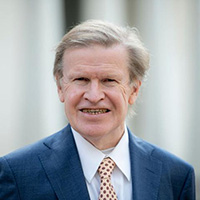
Harold James, a professor of history and international affairs, delivered a keynote address during an economic policy symposium, which was organized by the German Economics Ministry, in Berlin on November 10.
The keynote drew parallels to the past, referencing former German politician and economist Ludwig Erhard’s push for economic reforms after World War II. The address was appropriate for the moment — earlier that day, Katharina Reiche, the federal minister for economic affairs, spoke about a new plan to strengthen the German economy.
“Europe can play a key role in building a new institutional framework for stability,” James said.