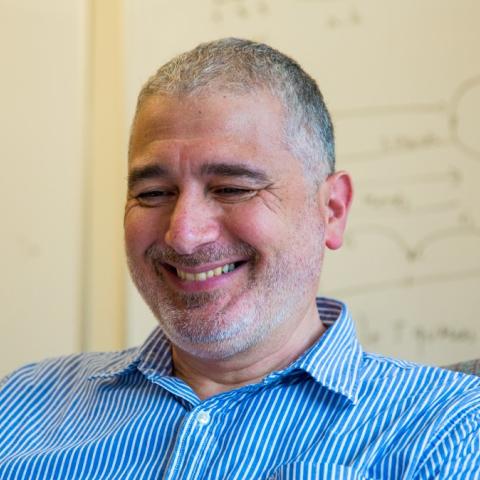
Stephen Rapp was United States Ambassador-at-Large heading the Office of Global Criminal Justice during 2009-2015, where he coordinated US Government support for international, hybrid, and national courts and tribunals prosecuting atrocity crimes. From 2007-2009, Ambassador Rapp served as prosecutor of the Special Court for…
FUNG PUBLIC TALK
Are citizens' assemblies a solution to solve two pressing crises: democratic dissatisfaction and climate emergency? The Citizens' Convention for Climate, and the Great National Debate in France, or the Conference on the Future of Europe, were attempts presented as new initiatives. Recently, many climate…
While we know that algorithms are an increasingly important part of what information people encounter in everyday life, little work has focused on studying users’ awareness and understanding of how algorithms may influence what they see and do. There is also more to learn about what actions users may be taking to try to…
The world needs to achieve net-zero greenhouse gas emissions by mid-century for a chance at limiting warming to less than 1.5°C. Last year, the Canadian government followed the lead of other nations and legislated a goal of net-zero by 2050. Achieving this goal requires shifting from incremental to transformational approaches…
This paper analyzes how temporary work assignments to poor areas affect preferences, beliefs, and career choices. We exploit random variation in the assignment of healthcare workers within a one-year mandatory rural service program in Peru. We show that healthcare workers that were assigned to poorer areas are more altruistic…
Law and computer science interact in critical ways within sociotechnical systems, and recognition is growing among computer scientists, legal scholars, and practitioners of significant gaps between these disciplines that create potential risks for privacy and data protection. These gaps need to be bridged to ensure in the…