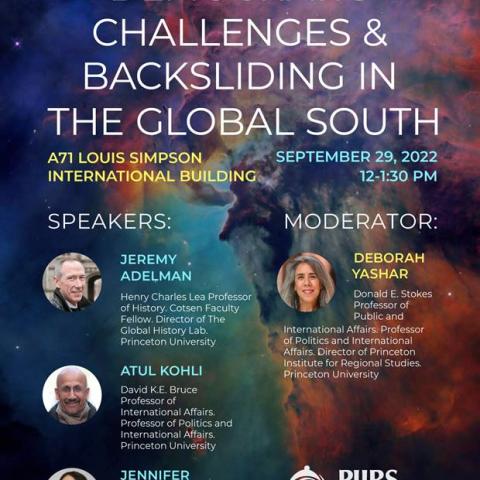
Democratic backsliding and autocratization are posing threats around the world. Anti-pluralist forces have challenged democratic institutions, civil liberties, and political norms. This panel will discuss these developments in the global south, with a focus on Latin America, Africa, and South Asia. A future panel will analyze…
In the first of a series of roundtables, the Afghanistan Policy Lab will convene a small group of leaders, experts, and Princeton students and faculty to discuss and further develop policy recommendations for the complex challenge of delivering humanitarian assistance in Afghanistan under the Taliban regime. The discussion will…
Open decentralized networking is a decades-old dream, the fabric enabling open, uncensored, global communication. Although this dream drove the design of the original Internet (web 1.0), technological, authoritarian and economic forces have combined to substantially centralize today’s communication infrastructure (web 2.0). The…
Veda Vaidyanathan is part of the tenth cohort of Fung Global Fellows at the Princeton Institute for International and Regional Studies for the 2022-23 academic year and specializes in Asia-Africa interactions. As a visiting associate fellow at the Institute of Chinese Studies (ICS) in New Delhi and an associate at the Harvard…
From speeches and op-eds to tweets and viral memes, modern rhetoric has many faces. Former speechwriter, Sam Lyman, unpacks how the forgotten art of rhetoric has been used historically, in ways both good and bad, to shape policy and move public opinion.