

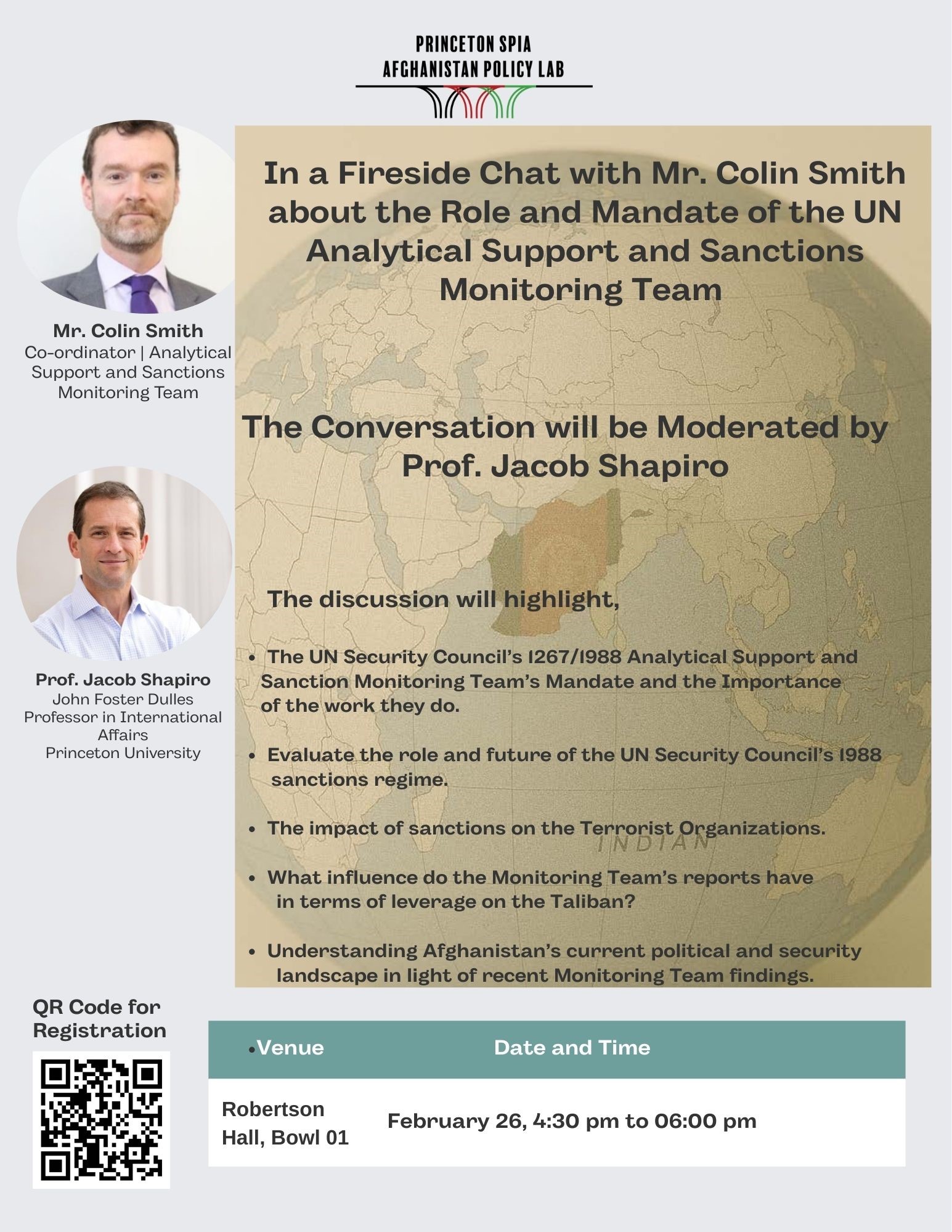
The UN Security Council’s 1267/1988 Analytical Support and Sanctions Monitoring Team has, for more than twenty-five years, played a central role in supporting the Council’s counter-terrorism sanctions regimes related to Al-Qaida, ISIL/Da’esh, and the Taliban. Mandated to monitor compliance with sanctions measures, including asset freezes, travel bans, and arms embargoes, the Team provides independent, evidence-based assessments of security developments in Afghanistan and the evolving global terrorist threat. Uniquely authorized to engage directly with intelligence and security agencies worldwide, the Monitoring Team brings a rare and authoritative perspective on both local dynamics and transnational risks. Its periodic reports to the Security Council serve as a critical basis for decision-making on sanctions policy, international engagement, and the future of the 1988 regime.
The Monitoring Team's most recent report on Al-Qaeda and Da'esh was published on 9 February 2026, while its report on peace, security, and stability in Afghanistan was published on 16 December 2025. Yet again, both reports underscore the continued presence of terrorist groups in Afghanistan, including Al-Qaeda, and raise concerns about the evolving threat environment. Nevertheless, the sanctions regime is under pressure; both the regime itself and the Monitoring Team's mandate are due to expire in mid-February, unless the Security Council can reach an agreement to renew it.
Twenty-five years after 9/11 and four years after the Taliban resumed to power, Afghanistan appears once again to be slipping from the forefront of international policy attention. While the country has experienced a degree of stability, but this has come with a significant cost. Many of the fundamental challenges faced by the country remain unresolved. In some cases, they have been exacerbated by years of conflict and political turmoil. The Taliban continue to seek international recognition and legitimacy. However, the regime is formally recognized by only one country. Under the UN Security Council Resolution 1988, key members of the Taliban remain under sanctions, including a travel ban, asset freeze, and arms embargo.
This discussion aims to explore the nature and durability of the Taliban regime, including the internal dynamics between Kabul and Kandahar, as well as the international community's engagement with it. It will take stock of the Security Council's decisions relating to the future of the 1988 sanctions regime and the political and security signals those decisions convey. The discussion will also examine the security situation inside Afghanistan and assess whether terrorist groups based there can once again project an external threat. Is the Taliban regime sustainable or if it rests on an unstable equilibrium? What would that mean for regional and international security?
Objectives:
- Understanding Afghanistan’s current political and security landscape in light of recent Monitoring Team findings.
- The impact of sanctions on Taliban’s regime
- Evaluate the role and future of the UN Security Council’s 1988 sanctions regime.
- Consider the implications of developments in Afghanistan for regional and international security.
Speakers
Mr. Smith assumed the role of Coordinator in October 2024. It involves overseeing and supporting the work of the Analytical Support and Sanctions Monitoring Team, working to UNSCR1267 (Al Qaeda and ISIL), as well as UNSCR1988 (Afghanistan). The Monitoring Team is mandated to engage with Member States’ national security and intelligence agencies.
The team monitors and supports implementation of the relevant sanctions’ regimes. It is also responsible for 6-monthly assessments on the global threat from Al Qaeda and ISIL (and their affiliates) – the latest reports are available here - and annual reports on peace and security in Afghanistan.
Immediately prior to that, he was vice president for delivery in an international development consultancy. Previously, he spent over 20 years as a British diplomat in the Foreign, Commonwealth and Development Office (FCDO). Throughout his career, he focused on national security issues, in particular counter terrorism.
From August 2021 to September 2023, he was Deputy Director in the FCDO’s National Security Directorate. He helped establish the FCDO’s Investment and Trade Security Department, led on Serious Organised Crime, and was head of the FCDO’s Counter Terrorism Department (CTD).
From September 2017 to March 2020, as Deputy Strategy Director, Mr. Smith headed the Projects Task Force of the Foreign and Commonwealth Office (FCO), overseeing a range of priority projects.
Previous roles include Head of the UK’s Syria Office in Istanbul, Türkiye (April 2015 to June 2017), engaging in the counter-Da’esh campaign in Syria, working with the Global Coalition. He was also seconded to the European External Action Service (EEAS) in Brussels (May 2013 to January 2015) where he served as Counter Terrorism Expert Adviser, including steering EU Syria and Iraq counter terrorism and foreign terrorist fighters’ strategy.
Jake Shapiro is Professor of Politics and International Affairs at Princeton University. Shapiro co-founded the Empirical Studies of Conflict Project, a multi-university consortium that studies politically motivated violence in countries around the world. He also leads Princeton’s Accelerator Initiative, which is working with partners on four continents to build infrastructure for scientific research on the information environment.
Shapiro has published more than 50 articles on conflict, economic development, security, and technology in a wide range of peer reviewed journals, as well as more than 100 policy articles, reports, and book chapters. He is author of The Terrorist’s Dilemma: Managing Violent Covert Organizations and co-author of Small Wars, Big Data: The Information Revolution in Modern Conflict. Shapiro has conducted field research and large-scale policy evaluations in Afghanistan, Colombia, India, and Pakistan. He received the 2016 Karl Deutsch Award from the International Studies Association, given to a scholar younger than 40, or within 10 years of earning a Ph.D., who has made the most significant contribution to the study of international relations.
Shapiro has advised government agencies, NGOs, and technology companies on a wide range of topics. He earned a Ph.D. in Political Science and M.A. in Economics at Stanford University and a B.A. in Political Science at the University of Michigan. Shapiro is a veteran of the United States Navy.
Sponsorship of an event does not constitute institutional endorsement of external speakers or views presented.