


Even for an industry constantly in flux, these are trying times in healthcare. An estimated 22 million Americans faced having their health premiums more than double at the end of last year, per KFF, and Medicaid will see nearly $1 trillion in cuts over the next decade, according to the Congressional Budget Office.
These policy shifts will likely result in millions of people becoming uninsured, and hospitals – which often bear the burden of treating uninsured patients – are already beleaguered. Approximately 40% of U.S. hospitals lost money last year, according to Becker’s Hospital Review.
Amid all this, there is a technology that holds the promise of transforming the healthcare industry, improving and expanding patient care, and cutting down costs: artificial intelligence. Yet AI comes with its own challenges and concerns.
That was the focus of the 2025 Systems Summit on Healthcare Transformation at the Princeton School of Public and International Affairs on Nov. 6 and 7. The Systems Summit is a biennial special event that brings together 100 of the nation’s preeminent thought leaders, along with Princeton SPIA faculty and students, for a systems-level exploration of pressing topics in healthcare.
“Healthcare is entering a new era, and I don’t believe we can look to policymakers alone to lead the future of care delivery,” said Bryant Adibe, a physician and Princeton SPIA faculty member who created the Systems Summit. “In fact, historically, the biggest transformations that have moved healthcare forward have always come from healthcare leaders themselves, who have come together to find solutions.”
This year’s event, sponsored by the American Medical Association (AMA), centered on the future of healthcare AI, clinical innovation, and the rapidly shifting landscape in health policy and healthcare economics.
“Physicians need training in AI, not just in the use of specific tools but in the fundamental principles necessary to fulfill our duty to protect patients,” said Kim Lomis, the organization’s vice president for medical education innovations, who collaborated with Adibe to design Summit programming. “AI has significant implications for both what and how we teach physicians, now and in the future."
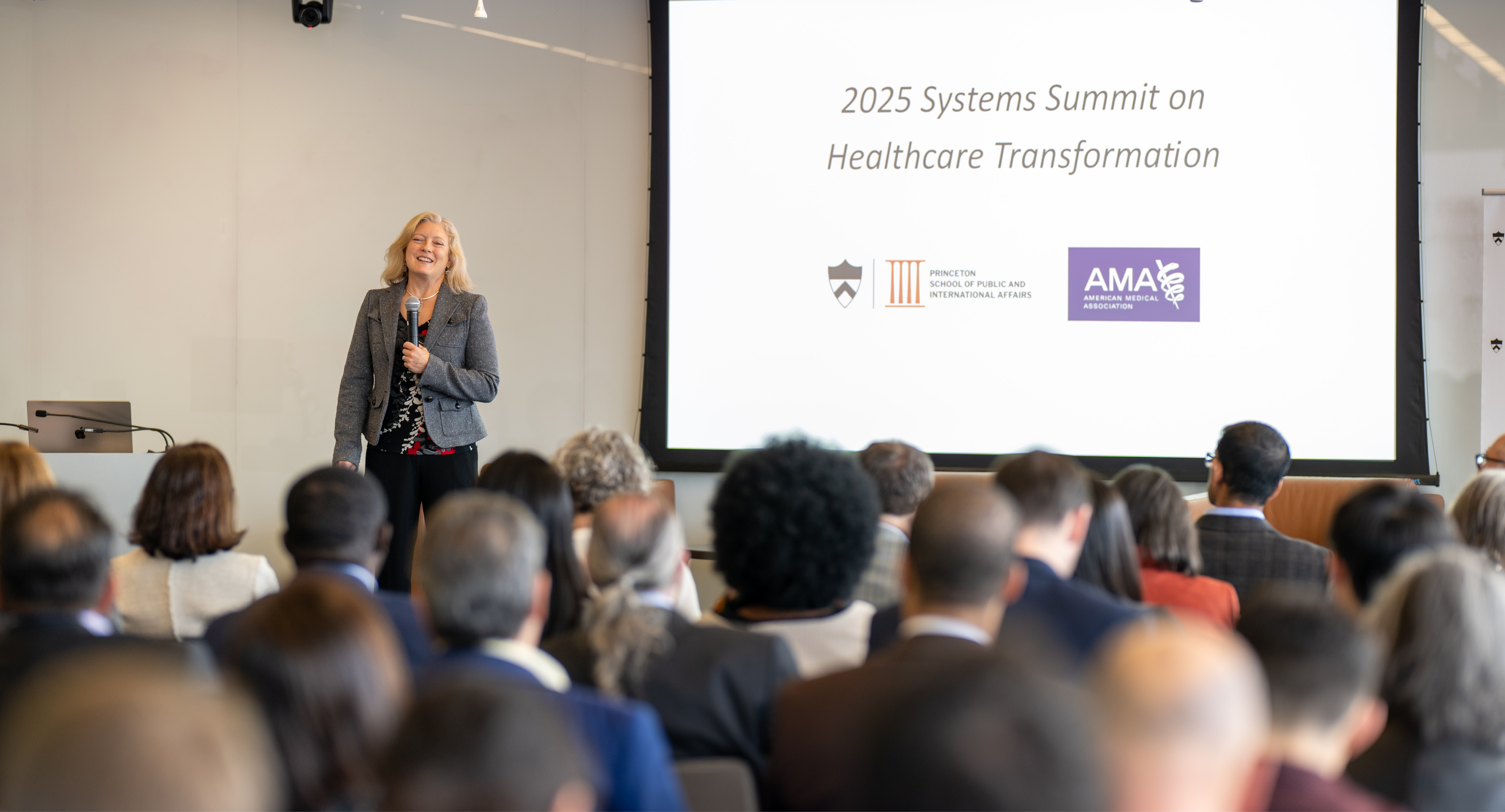
Photo by Sameer A. Khan/Fotobuddy
In an industry where medical records are still faxed between offices, the potential for AI to automate manual tasks and introduce efficiencies is difficult to ignore. Rural medical care in particular is poised to benefit from technology that enables doctors and nurses to do more with less, Adibe noted.
One much talked-about technology doctors are adopting are ambient scribes, an AI-based transcription tool that physicians can use to generate automated clinical notes during patient visits after obtaining consent. It cuts down on the manual work of notetaking and documentation, freeing providers up to focus on the patient.
“That 15 minutes we have for a conversation, I think we can make that so much richer,” said Chethan Sarabu, director of clinical innovation for the Health Tech Hub at Cornell Tech and a physician. “The healthcare system that takes the lead on, ‘It’s okay if you use ChatGPT, but here’s how you do it in a safe, guided way, that’s the healthcare system that is going to lead,” he said.

Photo by Sameer A. Khan/Fotobuddy
Yet many barriers exist to adoption of such tools, including resistance by healthcare providers to recording conversations – even if the data is not permanently stored.
Protecting patient health data is paramount, as is restoring trust and ensuring transparency between patients and providers, attendees said. They noted the degradation of public trust in physicians after the pandemic.
Others raised concerns about whether AI can be equitable as well as what the role of a physician will be when AI can independently provide diagnoses and write prescriptions – a scenario that is not too far-fetched. In 2025, a bill was introduced in Congress that would allow AI to prescribe medication without human oversight.
“This is why the AMA advocates for physician involvement at every step of AI design, deployment and monitoring, ensuring that AI leads to augmented intelligence,” said Sanjay Desai, chief academic officer and senior vice president at the American Medical Association.
The proposed bill has not advanced, but it sent a clear message about the role of policy in determining how the industry evolves. It also raises the question of how to balance safety and privacy with innovation.
That will be answered, in part, by students who will work on the most promising academic and policy recommendations raised at the conference as part of a new spring course, “Healthcare Leadership in Action,” being taught by Adibe.
Olivia Johnson ’26 attended the Summit and is enrolled in the course. She plans to become a physician and is majoring in molecular biology with a global health minor through Princeton SPIA.
“This conference touched on something that I think a lot of pre-med students are looking for: the opportunity to pick physicians’ brains and hear about their experiences in the medical industry,” Johnson said. “I’m hoping to use the course to think more critically about what I would like my future career to look like while also thinking about the financial and economic structures of the hospital and national healthcare industry.”

Photo by Sameer A. Khan/Fotobuddy
Top photo, from left to right: Chiquita Brooks-LaSure, MPP, Sr. Fellow, The Century Foundation; Fmr. Administrator, Centers for Medicare and Medicaid Services (CMS); Monica Bertagnolli, MD, President-Elect, National Academy of Medicine; Fmr. Director, National Institutes of Health (NIH); Bryant Adibe, MD, MS, Princeton SPIA faculty member
Photo by Sameer A. Khan/Fotobuddy